
THE $130 CIGAR
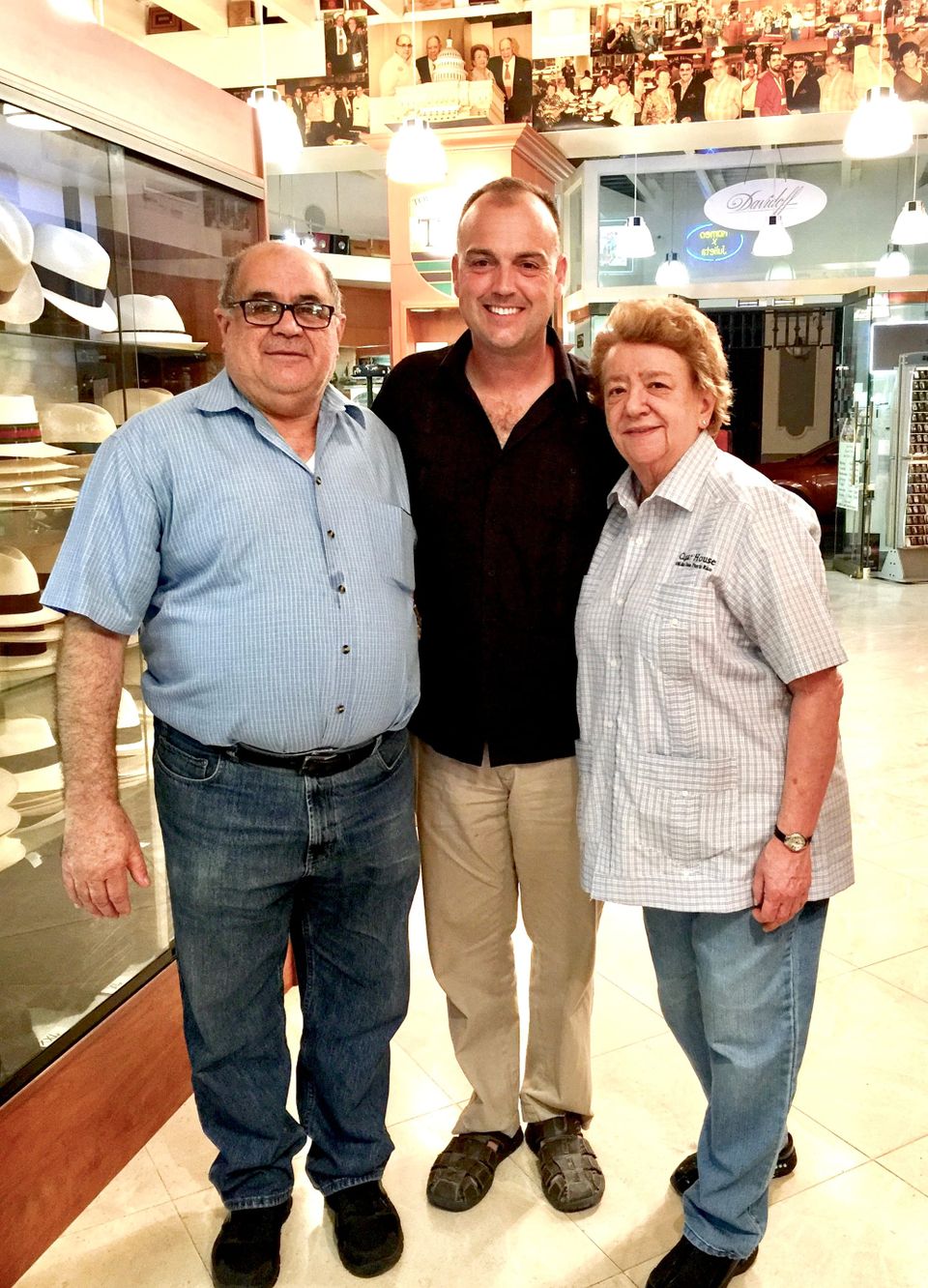
A few weeks ago my wife Napita handed me a cigar in Tampa that cost about $130. That’s not a typo. That is more than I have ever paid for something I intended to set on fire, and I say that as a man who spent a good portion of his adult life hanging extremely expensive things on fighter aircraft and then taking them someplace where the entire purpose was to make them disappear.
In the fighter community we have a phrase for that part of the day job: warheads on foreheads. That’s shop talk not intended for polite company. You don’t toast those. You employ them. A cigar… you’re supposed to enjoy that. So $130 remains my personal record in the recreational-combustion category, and I do not expect it to be broken.
She bought it in a proper cigar shop with a real humidor, in Tampa, which is not a branding accident. Ybor City earned the title Cigar Capital of the World over many years. Vicente Martínez-Ybor and others built factories there in the 1880s, and Cuban and Spanish cigar makers followed. For decades, hundreds of millions of cigars rolled out of brick factories where men sat at long tables and made a living one leaf at a time. I was born and raised in Tampa. The gift was not random.
Neither was the woman who bought it. Napita is a nurse practitioner. Yes, a nurse practitioner bought me a $130 cigar. It also happened to be the first time my wife ever gave me a cigar. I have elected not to interrogate the medical reasoning behind that decision. Sometimes a husband should simply accept a good thing. She also knew the other number: more than forty years in uniform, nearly thirty of them on active duty. The cigar was a retirement marker that happened to be tobacco.
But there is more to it than that. My wife grew up in a traditional Thai family with a lot of kids. Her father managed a railroad station. He worked hard, saved for the family, and had little taste for spending money on himself. I knew that type of man before I ever went to Thailand. I was raised by one. Actually, several.
I think of this story as taking place in five rooms. Only a couple of them actually had walls.
THE FIRST ROOM WAS A TRUCK
Edward Lawrence Vaughan Jr. WWII Navy, Machinist’s Mate Second Class, minesweeper. Grandpa would tell you he spent much of the war seasick and didn’t do anything particularly heroic. I disagree. If Band of Brothers had been about the Navy, he would have been one of the men in the background keeping the boat running while somebody else got the close-up. That was good enough for me. I flew fighters. He kept a minesweeper in the war. Different airframes, same country.
He was also, according to the official Vaughan family assessment, a cheap bastard. Dad said so. Grandma said so. Multiple witnesses corroborated the finding over Thanksgiving dinners spanning several decades. Grandpa was a Depression kid from Chattanooga, Tennessee, and cheap enough to make a Scotsman check his wallet.
There may even have been a genetic explanation. The Vaughans are Welsh, and family folklore says some of our Celtic ancestors wandered up into the lowlands of Scotland in the eighteenth century and made the questionable decision to help Bonnie Prince Charlie fight the English. This went poorly. The Jacobites eventually got thoroughly defeated, and according to the Vaughan version of history, our people decided shortly thereafter that North America offered superior long-term prospects.
How much of that story would survive peer review, I have no idea. That’s why God invented family folklore. What I do know is that the family came into southern Virginia, crossed the Blue Ridge and the Appalachians, and eventually wound up in Tennessee, where Grandpa was born.
He was a Southern gentleman. My father was a Southern gentleman. I was raised by both of them, so whatever else forty years in the Air Force did to me, I started as one too.
Dad was the best salesman I ever knew. He played minor league baseball for a while, tried college and decided it wasn’t for him, then went through an executive training program at a department store and eventually built a career in the furniture business, including starting a chain of stores of his own.
For much of my childhood, it was Dad and me. He was raising a boy while trying to build a business, and there are only so many places a seven- or eight-year-old fits into that equation. One of the solutions was grandparents. I spent a lot of time with both sets of mine. That’s how I wound up in Grandpa’s truck so often.
Dad’s gift was storytelling. He could talk to anybody, read the person across from him, find the thread that connected them, and start pulling on it. The story might be about baseball, furniture, Tampa, somebody he knew thirty years earlier, or something that happened to a cousin who may or may not have deserved everything that happened to him. By the time Dad finished, the customer wasn’t listening to a sales pitch anymore. He was in the story. Then Dad would close the deal.
That gift put food on our table. I grew up watching storytelling converted directly into income, although I wouldn’t have described it that way at the time. I just thought that’s how my father talked. Southern gentlemen tell stories, and we do not always burden a good story with unnecessary precision.
Grandpa worked commercial sales for International Harvester in Tampa. Every year they handed him a new company loaner vehicle. Scouts. Travelalls. Utterly reliable mid-century American iron. He kept those things so clean you suspected the truck occupied a slightly higher position in the family hierarchy than some of us did.
I would ride beside him in leather that still smelled new, machine grease somewhere in the cabin, and a cheap cigar burning. Hav-A-Tampa. White Owl. Machine-made, affordable, and available at roughly the same places where you bought motor oil. The exact opposite of a $130 retirement gem from a proper humidor.
That smell is still Grandpa to me: new car leather, machine grease, burning tobacco. I’ve looked. Nobody sells that candle.
When we got home, Grandma conducted what would now be called a post-mission sniff inspection. The cigar smoke was generally detected before we crossed the threshold, and she scolded both of us. Every time. Grandpa would receive the reprimand, acknowledge the finding, take no corrective action whatsoever, and eventually do it again. The operation was not covert. It simply wasn’t authorized.
I probably learned cigars from him first. Later I learned them from books. I was a voracious reader as a teenager and through college, and Hemingway got hold of me early. He had boats and wars and bullfights and Africa and men who occasionally dealt with the complexity of the human condition by pouring a simple whiskey and lighting something made of tobacco. This seemed to me a perfectly reasonable literary tradition. Years later I became a fighter pilot and discovered Hemingway had apparently been writing an operations manual… for me.
THE SECOND ROOM WAS A PARK
The other grandparents lived near the intersection of Central and Sligh. Striking distance to Ybor City with only one bus transfer. During the summers my cousin and I would often walk a long way from their house because we had nothing better to do, which in those days was considered an acceptable childhood activity. There were several parks with concrete tables and concrete benches, all of it bolted down. The city had apparently concluded that Tampa residents (and frequent tropical storms) could not be trusted with movable furniture. Some of the tabletops had chessboards set into them. Most were just slabs.
It seemed at some parks, the old Cuban men owned those tables. Nobody had a deed. Nobody needed one. Dominoes, cigars, cafecito with azúcar morena whipped into espumita on top. Maybe a thin one of rum if I remember the bottles correctly, and whiskey when rum wasn’t the point.
They wore guayaberas, those four-pocket Caribbean shirts that somehow make an older gentleman look as though he has someplace dignified to be even when he is only going as far as the next domino game. The real caballeros wore white ones with long sleeves. I have since owned several guayaberas. None have produced the same effect. And I don’t feel like I’ve earned the right to wear the white ones. It turns out the shirt is only about a third of it.
The smell was cousin to Grandpa’s truck: tobacco leaf, heat, a little sweetness, and somebody’s cologne that gave up the ghost around noon. On solo treks, I would hang around the edge watching the action. The old men didn’t pay much attention to me, and they didn’t need to. I was getting the lesson anyway.
Years later I understood what I had been looking at. Ybor’s cigar factories had brought families, language, food, politics, arguments, and an entire culture with them. The culture spilled into neighborhoods across Tampa. At the time I knew none of that. I just knew those men smelled a little like Grandpa. Same country, different accent.
THE THIRD ROOM WAS AN OFFICERS’ CLUB
By the time I was flying F-16s, cigars had followed me into another tribe. I am a life member of the Red River Valley Fighter Pilots Association, the River Rats. That organization was born in Thailand during the Vietnam War. In May 1967, Scrappy Johnson called the first tactics conference at Korat. Robin Olds brought a group over from Ubon. Chappie James and other legends were there. They were trying to figure out how to fight over the Red River Valley and, preferably, come home afterward.
They talked tactics. Then, as Scrappy later put it, the organization was baptized in a lake of liquor. This is the sort of professional association I understand.
Cigars and whiskey have long been unofficial afterburners in the fighter community. Not because we’re trying to look like a movie. The work is loud and violent, yet fast and precise, and then suddenly it isn’t. The jet is chocked. The engines stop. Nobody is shooting at you for the next hour. A cigar burns slowly, and a short pour disappears slowly if you have sufficient discipline. Somebody has to turn down the volume.
Medical issues and VA disability ratings notwithstanding, River Rats still occasionally accomplish this with tobacco and brown liquid. Fighter pilots have always possessed a remarkable ability to hold two apparently contradictory ideas in their heads at once. We can discuss cardiovascular health while looking for a cigar cutter.
From 2011 to 2013 I was a colonel at Air University in Montgomery, Alabama. I also had what the Air Force calls an additional duty, teaching at Air War College and serving as adjunct faculty at other schools, including the Joint Forces Staff College in Norfolk. Like many additional duties in the Air Force, it eventually became most of my job.
Somewhere in there I went looking for the Alabama River Rats. They had disappeared. There had once been a chapter, and there had once been somebody running it, but by the time I arrived nobody seemed quite certain what had happened to him. Maybe he moved. Maybe he passed away. Maybe he simply wandered off with the membership roster. Old fighter-pilot organizations occasionally suffer from administrative processes that would not survive close inspection by the Internal Revenue Service.
So I called the national organization and we resurrected the Alabama River Rats. For reasons that probably made sense to somebody at the time, I was declared acting CINC. This placed a relatively young Air Force colonel temporarily in command of a collection of men who had been flying combat missions over Southeast Asia when I was still working on a bicycle. I knew enough to understand that I needed adult supervision.
So I wrote a letter to Scrappy Johnson. Not an email. A letter, by hand. Scrappy was an elderly gentleman by then, although “elderly” did not adequately describe the amount of kick still contained in him. I invited him to Montgomery to help us bring the Alabama Rats back to life. And damned if he didn’t come.
He brought his beautiful wife, and my wife and I hosted them. One of my closest friends from several combat tours, callsign Elvis, flew in and stayed at our house to help run the operation. Yes, Elvis. I told you this was a Southern story.
We took over the Officers’ Club at Maxwell and started calling dormant Rats out of whatever holes they had crawled into. They came. So did younger pilots, and the old stories came with them. We ate. We drank. Cigars appeared and whiskey disappeared. Scrappy sat there watching another generation carry on something he had started in Thailand almost half a century earlier. The Alabama River Rats were alive again.
Eventually we found the right man to relieve me and did something dangerously close to democracy by actually electing him. The man who runs the Alabama organization today is a Navy pilot of Vietnam vintage. Naturally, he owns a cigar lounge. Naturally, it is in Montgomery. And naturally, I eventually discovered that while I had been trying to resurrect an organization historically associated with fighter pilots, whiskey, and cigars, the man we needed had been operating a cigar lounge less than a mile from where I lived.
There are moments when the universe is subtle. This was not one of them.
THE FOURTH ROOM WAS A SMALL HOUSE IN A FRONT YARD
That was Uncle Na Nit’s place in Thailand. It sat in the front yard of my wife’s family home. In Thai families everybody gets a nickname. A fruit, a trait, a look, something that made perfect sense at the time and perhaps nobody remembers anymore. Na Nit described a small man, and he was. But he was also wiry in that strong way that southeast Asian soldiers carry well. Eternal bachelor. Thai Army. Vietnam veteran. One year during that war he was recognized as the lead Thai army marksman for popping VC on the HCM Trail.
I don’t turn that into something it wasn’t and call him a modern sniper. I just know that if the Thai Army handed out an award for putting bullets where they were supposed to go, Uncle Na Nit apparently had a pretty good year.
He didn’t spend money on expensive things. Partly because there wasn’t much extra. Mostly because extra money was supposed to go toward something useful. I recognized the philosophy immediately. It had a Tampa accent when I first heard it.
His everyday bottle was Mekhong, Thailand’s old brown liquid that everybody calls whiskey even though it is made mostly from cane and rice and is closer to its own peculiar category of moonshine. When Thais wanted to step up, Johnnie Walker was a familiar answer. So on one trip my wife bought Na Nit Johnnie Walker Blue.
This created a problem. Blue was far too expensive to drink, so he hid it. Where, exactly, I don’t know. Perhaps he was saving it for the King. Perhaps to sell. Perhaps he simply enjoyed possessing one bottle of whiskey too expensive to consume. The important operational fact was that nobody was getting into the Blue.
My wife knew her uncle. So on another trip we adjusted tactics and bought Gold. This is one of the reasons she and I have been together so long. Faced with a failed operation, she does not complain about the target. She changes the weapon.
Through a brother-in-law interpreting, Na Nit explained that he tried to stay away from really expensive whiskey because he didn’t want to develop a taste for it. That might render moonshine undrinkable. Then he poured ours. The philosophy held perfectly. Never waste your own money developing expensive tastes when relatives are available to subsidize them. I understood him immediately. He was Welsh. He just didn’t know it.
I got to sit with a veteran of another country’s army who had fought beside ours in the same war that created the River Rats. I got to put a good bottle in his hand and thank him for what he had done alongside our country in that war. My wife made that possible too.
Na Nit died a few years later. That’s the thing about these rooms. Eventually somebody gets up from the table and doesn’t come back.
THE FIFTH ROOM WAS A COCKPIT
And then all the places the cockpit took me. Before I was a fighter pilot I was a a ski-plane pilot. And before that a rated celestial navigator. Before that I was a manufacturing engineer. I’ve had a pile of jobs, including one that involved welding rototiller frames on third shift, which I mention mostly so nobody concludes the cigar habit originated with disposable income. The job that lasted, and the one that carved most deeply on my personality, was combat fighter pilot.
I’ve smoked cigars in Bahrain, Saudi Arabia, and Kuwait. I’ve smoked them in Azerbaijan, Moldova, Guavate (IYKYK) and Kenya. I even smoked one in Afghanistan. I’ve smoked more than a few in Iraq, some in places where the cigar was the only thing in the immediate vicinity that wasn’t government property. And a thousand other places. None cost $130. Most cost whatever the guy next to me had paid, which was usually not much and which he would deny anyway.
The leaf doesn’t care what the map says. The ritual does. Sometimes you’re killing time between sorties. Sometimes you’re marking the fact that the sortie is over. Sometimes you’re sitting beside somebody who will be flying with you again tomorrow. And sometimes, although you generally don’t know it at the time, you’re sitting beside somebody you will spend the rest of your life remembering. The cigar gives men who aren’t particularly good at sitting still an excuse to sit still.
From 2015 to 2017 I had the honor of commanding the Air Force’s only fully bilingual flying wing at Muñiz Air National Guard Base in San Juan, Los Bucaneros. My family came with me. Then the family left early and I stayed for the last six months with mi familia Boricua. Later I came back to help after Hurricane María. Later still, as a one-star, I returned to help that wing leave the flying mission after a tragic crash and take on a new one. Still valuable and still lethal, just in a different way.
Puerto Rico sits a short stretch of Caribbean water from the Dominican Republic, where many of the world’s great cigars are now grown and rolled. And there they were again: older gentlemen in guayaberas, rum, cafecito, cigars, dominoes. The tables were not bolted to the ground, which I took as evidence of a higher-trust society.
I had traveled a long way from those childhood summers in Tampa to discover that somehow I kept arriving in the same room. Grandpa’s truck. The Cuban men in Ybor. Scrappy at Maxwell. Na Nit in Thailand. Fighter pilots scattered across the Middle East. Old men in Puerto Rico. Different countries, different uniforms, different languages. Same basic arrangement.
I have now spent enough years in these rooms to notice the pattern. Nobody was trying to be rich. Nobody was trying to look important. And the cigar was never really the point. The cigar was the excuse for sitting still, and sitting still was the thing most of these men would never have done without an excuse.
Grandpa wouldn’t. The men playing dominoes wouldn’t. Na Nit wouldn’t. Fighter pilots definitely won’t. Give any of them a cigar and a glass and suddenly they have permission to remain in one place for an hour. Take those away and somebody is going to stand up and start looking for something to fix.
THE LAST ROOM
The last room hasn’t happened yet. It’s wherever I finally light the $130 cigar.
I’ve thought about this more than a reasonable person should. There’s a version of me that saves it for some future milestone, which is exactly how perfectly good bottles of Johnnie Walker Blue wind up hidden somewhere in Thailand for years. My wife has already conducted that experiment. It failed.
There’s another version that treats the cigar like a test article: smoke it alone, take notes, examine the ash, report findings back to the nurse practitioner who procured it. She would not be impressed by that either.
So here’s the plan. A porch. Late afternoon. The rest I’ll play by ear during that one golden hour.
Member discussion