
NOUS AVONS LA MONTRE
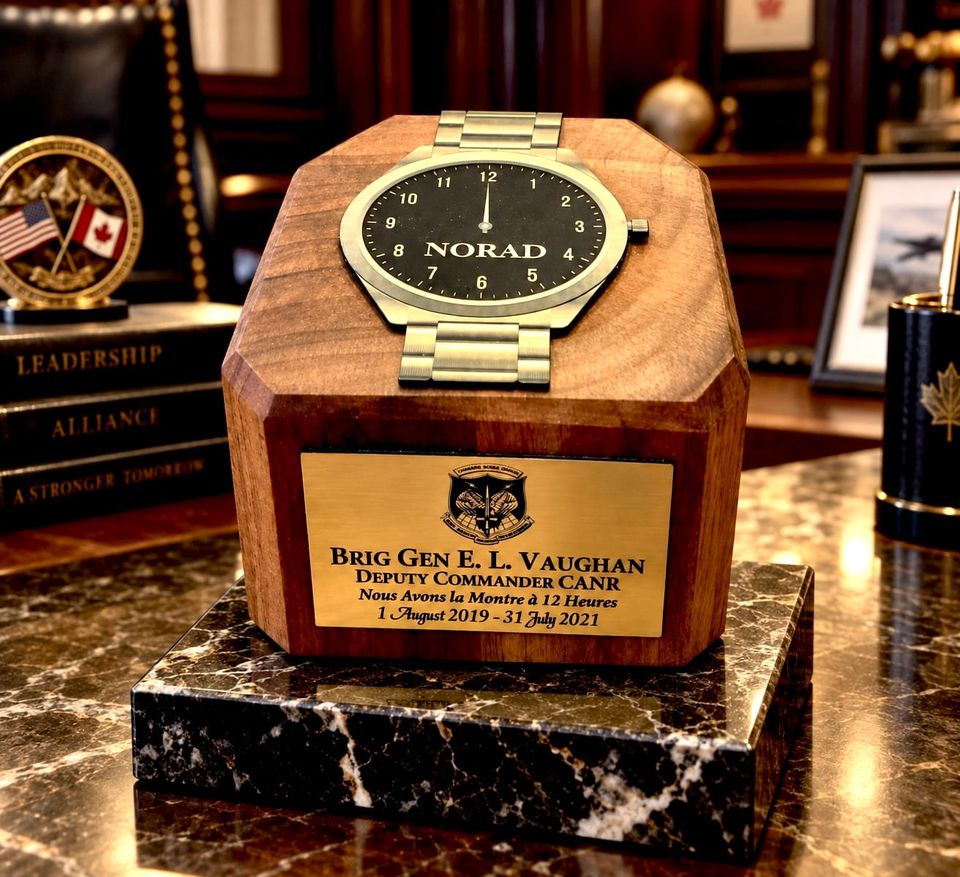
There’s a walnut block on my desk. Mounted on top is a NORAD wristwatch, hands frozen at twelve. On the front is a brass plate with my name, my old title, a line of French, and two dates: 1 August 2019 to 31 July 2021.
The line of French is a mistake. My mistake. And the Canadians who gave the block to me made sure I’d never forget it.
I’ll explain. But first you need to understand the job, because the job is how the mistake happened.
THE JOB
For two years I was the senior American military officer in Canada, as a one-star general. Not the defense attaché. Every country has one of those, the SDO/DATT, and in Canada that’s a Colonel or Navy Captain who works political matters directly for the Ambassador. I coordinated with him constantly. My job was different. Mine was operational.
I was Deputy Commander of 1 Canadian Air Division in Winnipeg. Canadians say “one CAD.” The post goes back decades, and the people who held it before me include Steve “Seve” Wilson, who went on to serve as Vice Chief of Staff of the Air Force and retire as a four-star, and Chris “Kathy” Ireland, who handed it to me. Derek “Maestro” O’Malley, a good friend and now a serving two-star, followed immediately after me. I was the first Air National Guard general to hold the fully built-out version of the post. The active duty Air Force tends to keep this one for itself. The experience is that good.
It’s really three jobs in one. Inside the RCAF, I was the flag officer deputy responsible for force employment. Two Canadian one-stars sat beside me, one for force generation and one for force development. Between the three of us, we covered the lifecycle of Canadian air power: build it, train it, use it.
I was also the deputy Joint Force Air Component Commander for the Canadian Armed Forces. That meant global air operations. When my boss was gone, I became the acting JFACC. After some intensive briefings and a lot of trust from my chain of command, they let me exercise that authority fully.
The third job, and the one most Americans recognize, was Deputy Commander of the Canadian NORAD Region. It mirrored the Canadian one-stars serving as deputies in the Alaskan and Continental regions. That symmetry is part of the NORAD structure. It’s the hat most people associate with the job, but it probably took a quarter of my time.
Here’s the easiest way for an American to understand the Canadian side. The Canadian Armed Forces have roughly two combatant commands. One is special operations. The other is Canadian Joint Operations Command, CJOC, which is something like rolling our geographic and functional combatant commands into one three-star headquarters in Ottawa. CJOC commands Canadian operations at home and around the world.
My boss was the air component commander, and the RCAF owns essentially all Canadian military aviation. The Chinooks carrying the Army belong to the Air Force. The Cyclone helicopters flying from Canadian frigates are flown and maintained by Air Force detachments. Even the aviation supporting Canadian special operations belongs to the RCAF.
That made the acting JFACC part of the job especially unusual. I could find myself exercising command and control over maritime aviation, Army-supporting aviation and other air operations at a scale an American one-star would almost never see back home. Maybe there’s an equivalent somewhere in the U.S. special operations world, but even there it would be rare. It was an extraordinary amount of responsibility for a one-star, and an extraordinary amount of trust to place in an American officer.
There’s an important distinction here. I never wore a Canadian uniform. I wore the uniform of the United States Air Force every day. But legally and from a command-and-control standpoint, I served inside the Canadian structure. That is a very unusual arrangement between two countries, and it tells you something about the relationship before you know anything else about this story.
WINNIPEG
Winnipeg is due north of North Dakota. That tells you most of what you need to know about the climate. The geography of the continent helps funnel Arctic air straight down onto Manitoba, and we’d go days in a row with a high around minus thirty. At those temperatures, nobody much cares whether you’re talking Fahrenheit or Celsius. The locals had plugs hanging out of the front grilles of their cars for block heaters, and you could plug in almost anywhere.
I loved it. The job also took me all over Canada and abroad, so I got to see more of the country than many Canadians ever do.
THE TEAM
My first commander was Major-General Alain “Data” Pelletier. We’d been classmates at the U.S. Air War College more than a decade earlier. When he left Winnipeg in 2020, he went to Colorado Springs as Deputy Commander of NORAD, put on his third maple leaf, and eventually retired as a Lieutenant-General in the RCAF. Major-General Eric “Slice” Kenny took over from him. Slice and I had been friends for years and had spent much of that time at roughly the same rank. Slice also promoted to his third maple leaf and became the commander of the RCAF, from which he recently retired. Working directly for one of your good friends while serving inside another country’s military command structure is a rare thing.
My two Canadian one-star peers, Luc Guillette and Iain Huddleston, became two of the closest friends I made in forty years of service. If you looked at the Canadian general officer roster from those years, my name sat right there beside theirs under 1 Canadian Air Division. An American officer, in an American uniform, sitting inside the Canadian order of battle.
Luc was a tremendous athlete and regularly competed in triathlons. He and his family also had an amazing backyard that was a bit like a five-star resort. Iain and I, and our families, found ourselves over there fairly often visiting. As I write this, Iain now serves as the NORAD Deputy, three-star in Colorado.
The three of us even had a club: the Raptors. Our two-star boss wore about five hats, and in meetings where it was just the four generals in a room, he’d hear you out completely if you disagreed with him. Then he’d decide, and that was that. As it should be. We joked that if we ever really wanted to move him, none of us could do it alone. It would take all three, working together, like velociraptors taking down a T-Rex. We had one-star “raptor” coffee mugs made. Naturally, they started showing up at staff meetings.
I mention all of this because the level of trust matters to the story. That trust extended to the First Air Force American joint detachment collocated at the headquarters. They weren’t assigned to me, but supporting my work was a big part of their mission, and one of my duties was helping pick their Lieutenant Colonel commander each cycle. I even got in the habit of choosing Army officers for some of those slots. It worked.
The important point is that I wasn’t a liaison looking into the Canadian chain of command from the outside, and I wasn’t an advisor standing beside it. I was an American officer serving inside it.
QUÉBÉCOIS FRENCH
Canada has two official languages, and inside the Canadian military that is serious business. Senior officers had required language profiles, and I knew RCAF Colonels who were otherwise ready for their first maple leaf but needed to improve their French. Native French speakers from Québec faced the same requirement in English. Language proficiency wasn’t something you earned once and put in a drawer either. People got tested again.
There was a practical reason behind all of it. A young Canadian who joins the military from a French-speaking town may not have much English. A senior officer needs to be able to talk to that troop, give an order and be understood. Every alliance has things one country treats as fundamental and the other barely thinks about. This was one of them.
The American general who rotates into my job every couple of years usually doesn’t arrive with that level of French. There was an exception for us, and the Canadian government provided French instruction. My instructor came right to my office, and I could train as often as my schedule allowed.
I arrived with restaurant French. I could greet people and order dinner. I couldn’t command a military in it. So I made sure I had Colonels and executive assistants around me who were fluent, took the lessons seriously, and got better. But three jobs didn’t leave much room for a full course of study, and I never reached anything close to a testable level.
Hold that thought.
THE GENERAL WHO SPOKE FRENCH AT ME
When my boss was away, which happened fairly often, I’d fill in for him at CJOC’s weekly classified operations meeting. I’d sit at the head of the table in Winnipeg, staff down both sides, and we’d join Ottawa on the screen.
For my first year, the CJOC commander was Lieutenant-General Mike Rouleau. He had one of those careers that gets your attention before he ever walks into the room. Artillery officer, JTF2 assaulter and commanding officer, commander of Canadian Special Operations Forces Command, and then the three-star responsible for Canadian military operations around the world. After CJOC, he became Vice Chief of the Defence Staff.
I respected Mike then and I respect him today. He was direct, operational and demanding, and I liked that about him. He expected the Canadian Armed Forces to be ready and lethal, and he expected his generals and admirals to operate in both official languages. I was serving in his chain of command, so that included me.
The first time I sat in, I wasn’t ready. The meeting moved between English and French without warning, sometimes in the middle of a sentence. I’d seen something like it as a Wing Commander in Puerto Rico, where the Adjutant General ran meetings mostly in Spanish. But this was global operations moving fast. A sharp young officer sat beside me and quietly gave me the English whenever the room shifted into French, and I kept up.
Then it was our turn. General Rouleau asked me a couple of questions in French.
I had no idea what he’d just asked me.
I turned to my whisperer, got the translation, and answered. Rouleau smiled and nodded. It wasn’t hazing and it wasn’t a joke. He wasn’t trying to embarrass the American. This was simply how business got done in his military. I wasn’t a visitor. I was in his chain of command, and that chain operated in two languages.
From then on, I prepared a few lines before every CJOC meeting. When he called on me, I’d open in my very best Québec French before switching to English. A year into the job, I could even banter briefly when one of the Canadian generals came at me in French in the hallway.
Which brings me to the memo.
THE MEMO
The Canadian Combined Air Operations Centre fell under my portfolio. The CAOC commander, Dave, an RCAF Colonel and a Québécois, reported directly to me.
About a year into the tour, I had to put out guidance to the CAOC. I worked hard on it. It was direction, but it was also meant as encouragement about the alliance and about working across all three NORAD regions, including Alaska and the continental United States.
Canadian military policy memos went out in both languages, so my translator and I built the French version together, carefully. I wanted to close with NORAD’s motto: “We Have the Watch.” It comes from the old idea of standing watch. You have the duty. You’re the sentry. For NORAD, you’re standing watch over two nations.
I had left the motto out of the French draft and noticed it just before we were about to print. After a year of French lessons, I had just enough confidence to be dangerous, so I typed the last line myself:
Nous avons la montre.
There was just one problem. Montre is a wristwatch. A duty watch is la veille or la garde. A ship’s watch is le quart.
What I had written at the bottom of a general officer’s guidance memo was roughly:
WE’VE GOT THE WRISTWATCH.
It read like a general reminding his headquarters that somebody was holding the Timex.
THE BEER
The Colonel caught it before the memo went anywhere. He came into my office chuckling, told me I owed him a beer for that one, and helped me fix it.
I told Slice. We had a good laugh. A cultural faux pas, in French, in front of the one Québécois officer in my chain who was guaranteed to catch it. And that, I thought, was the end of it.
It wasn’t.
A year later, on my way out the door, the team gave me a walnut block topped with a NORAD wristwatch. The hands were set at twelve. On the brass plate were my name, my title, my dates in Canada, and my French.
Except they’d improved it:
Nous Avons la Montre à 12 Heures.
We have the wristwatch at twelve o’clock.
Any fighter pilot reads that immediately. Twelve o’clock is straight ahead. Nose on. They had taken my French blunder, turned it into a fighter-pilot tally call, and then set the hands on the watch to match.
That is world-class staff work.
WHAT I TOOK HOME
I keep that block where I can see it. Partly because it’s funny. Mostly because it reminds me of something: on my best day, with the best intentions, I still needed the Canadian in the room.
That may be the alliance in one object.
The United States and Canada are allies twice over, through NORAD and NATO. I don’t know another military relationship quite like it. I got to spend two years living inside it, wearing the uniform of the United States while serving inside a Canadian command structure. The Canadians in this story, and many more I couldn’t possibly fit into it, are still my friends.
Governments change. Politics moves around. Headlines come and go. But the alliance I knew was built much closer to the ground. It was built by people working together every day, trusting one another with real responsibility, catching each other’s mistakes before anybody else saw them, and occasionally putting one of those mistakes on a brass plaque so you’d never forget it.
The beer is still owed.
À mes amis canadiens, merci. Je me souviens.
Member discussion