TWO F-16s OVER CHICAGO: MY 9/11 STORY
Most of the country spent September 11, 2001 in front of a television.
That’s not a criticism. There was nothing else to do. Pew’s first survey after the attacks found that 90 percent of Americans got their news that week from TV, and a majority said they couldn’t stop watching even though most found it frightening. Seventy-one percent said they felt depressed. Half couldn’t concentrate. A third couldn’t sleep.
People remember the second plane hitting, the towers coming down, the missing-person flyers covering lower Manhattan. They remember the helplessness.
My experience was different. I got a lever. That’s the difference between my story and most people’s, and it’s the reason I’m writing it down.
CORNFIELDS
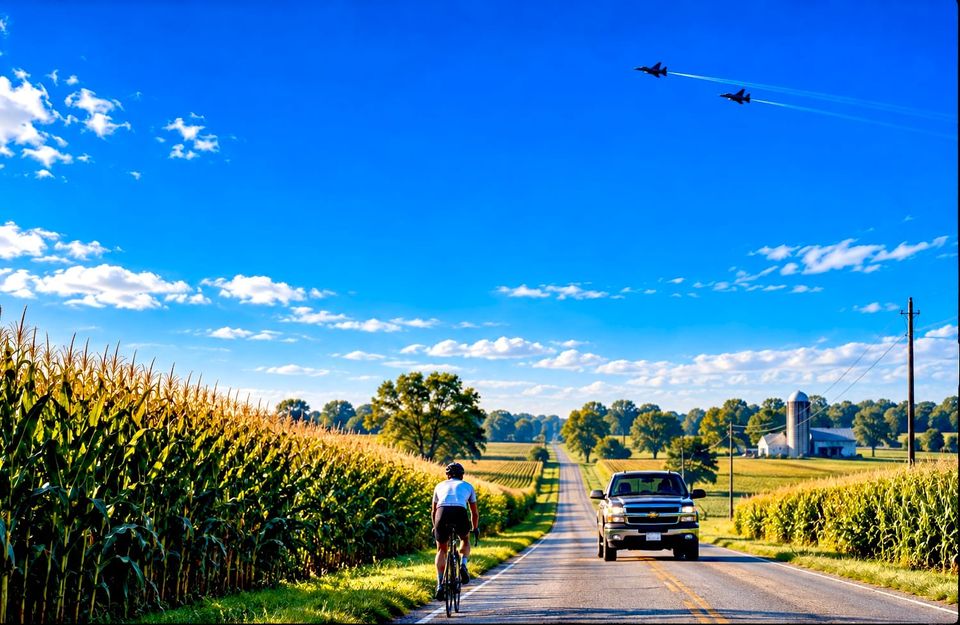
It was a beautiful late-summer Tuesday in Indiana. Clear blue sky, warm without being hot. Less than a year earlier I’d transferred from the 174th Fighter Wing in Syracuse, New York, to fly F-16s with the 122nd Fighter Wing at Fort Wayne, the Blacksnakes. I was still living in an apartment while the purchase of my farm worked its way through.
We were on a night-flying schedule that week. The squadron would come in around midday, fly an afternoon hop, debrief, then go out again after dark for night vision goggle work and nighttime employment. I wasn’t due in until later, so that morning I was on my bicycle riding the roads through Indiana farm country. I had no idea the towers had been hit.
The manager at my apartment complex knew what I did for a living. She got in her pickup truck and went looking for me. She found me somewhere out among the cornfields, and I still remember how she said it:
“Throw your bike in the back. I think you need to go to work.”
She filled me in on the drive back. I changed into my flying gear, packed my overnight stuff, and headed for the squadron. I wasn’t alone.
A lot of fighter pilots had reached the same conclusion without being told. Guys were showing up before anyone had called them. Eventually the formal recall started, but by then many of us were already there, and some of us were making the calls ourselves to get the rest of our teammates in.
Like everybody else in America that morning, we wanted to do something. The difference was that our profession gave us some options. The hard part was figuring out what to do with them.
WHAT WE DIDN’T KNOW
In hindsight it’s easy to forget how little anyone knew around noon on September 11.
New York had been hit. Washington had been hit. Flight 93 was in a field in Shanksville, Pennsylvania, which told us there had been at least one more airplane pointed at something. Was there a second wave? Who had launched it? Which cities were next? Nobody knew.
The FAA grounded everything and closed the national airspace.
The images everyone remembers include the F-15s coming out of Massachusetts toward New York and the DC Guard F-16s launching out of Andrews. There was another wave of fighters that gets less attention. Our friends in the Vermont Air National Guard’s Green Mountain Boys launched to cover New York. Other Guard units were getting airborne or preparing to do the same around the country.
At Fort Wayne, we were assembling people, figuring out how to get live missiles onto airplanes, talking to higher headquarters, and trying to understand our part in what was rapidly becoming a national air-defense effort.
There was also an enormous amount of cross-talk between fighter units. We were calling friends around the country.
What do you know? What are they telling you? Are you flying? What are you carrying?
They were asking us the same questions. Units that had already launched passed along whatever they’d learned. Nobody had the whole picture, so we built one from pieces.
Aside from being an instructor fighter pilot, my full-time staff job at Fort Wayne was Wing Plans Officer. It’s a fairly technical job, but it mattered that day. I handled the classified version of the wing’s combat mission statement and worked with the wing and our higher headquarters to make sure we were organized, trained and equipped to perform those missions to wartime standard.
I knew our mission set. Domestic air defense, what we called Airspace Control Alert or ACA, wasn’t in it. We were going to have to put together a pickup game.
Our sister unit, the 181st Fighter Wing down in Terre Haute, also flying F-16s, was poised to cover the first launches. Our tasking came through the national command-and-control structure: defend Chicago. Other fighter units were getting other cities. Detroit. New York. Washington. Los Angeles. Minneapolis.
The catch was that home-station training doesn’t require live missiles on the airplanes. So the ammo and weapons people went to work.
Indiana was fortunate to have munitions close enough to make that possible. Missiles came out of storage and maintainers started hanging them on jets. A couple of aircraft went up early without missiles simply to establish a fighter presence over Chicago. Armed aircraft would follow.
It was disciplined improvisation. Move fast, but don’t just start launching airplanes randomly. Get weapons. Get communications. Figure out who is controlling you. Understand the mission as best you can. Then go.
THE COT
At some point I realized I wasn’t going home. We weren’t an ACA unit, which meant we didn’t have an alert facility with beds and living spaces for fighter crews waiting for a scramble. So I went to supply and got one of those old Army folding cots, green canvas stretched over wood and metal.
Anyone who has assembled one knows the design. They’re nearly indestructible once you get them together, but getting them together usually involves a bruised knuckle, a cut finger, profanity, or some combination of the three.
I put one in my office and laid out the sleeping bag from my go kit. That became my alert facility.
That little cot captured the day pretty well. We were rebuilding a mission in real time with whatever we had.
THE TWO-SHIP
As an Air Force major, I was tasked to lead a two-ship. My wingman was Maddawg.
We weren’t simply squadron mates. We’d trained together, deployed together and flown together for years. He and a few others were the reason I’d transferred to Fort Wayne in the first place. I’d met them on combat deployments, and when the Blacksnakes had an opening, they called.
Maddawg is one of the most solid guys I’ve ever known. So when the country needed a pair of F-16s over Chicago that night, it happened to be two friends at the top of our game.
I don’t remember our exact takeoff time. It was somewhere around 10 p.m., give or take, and our primary vulnerability period carried us across midnight and into the early morning.
There was some discussion about crew duty day and fatigue. We dealt with it pragmatically. We were in a national emergency. Nobody intended to do anything stupid, but nobody was going to let a technicality or some piece of red tape prevent us from doing the mission either.
An F-16 isn’t a particularly comfortable place to spend several hours, especially when you’re six feet tall and about 185 pounds before adding equipment. G-suit, harness, survival gear, helmet, and because we were operating around Lake Michigan, an inflatable flotation horse collar around the neck. Once you’re strapped in and the canopy comes down, there aren’t many inches left in any direction.
There’s also very little room to store anything. Anything loose in a fighter cockpit becomes something you have to think about if you end up ejecting. But we were going to be up there awhile, and I wanted caffeine.
In those days I drank coffee from a thermos. I normally wouldn’t have brought a big one into an F-16. Then again, a normal night sortie might run a couple of hours, maybe three and a half with aerial refueling.
This wasn’t going to be normal. So the thermos came with me. So did the piddle packs.
THE BRIEFING
We tried to keep everything we could normal.
That’s one of the ways fighter aviation deals with abnormal situations. Standardization gives you something solid while everything around you changes.
Every fighter squadron has a book of squadron standards. It covers the things we don’t renegotiate every time we fly: formations, procedures, communications, responsibilities, and dozens of other details. A flight lead can say during a briefing that anything we don’t specifically cover will be done according to squadron standards. That sentence was worth a lot that night.
We were in one of our small briefing rooms with whiteboards. Normally I would put up the mission objectives and walk through the flow: when we’d arm systems, when communications and emissions changed to combat configurations, how we’d approach the fight, use radar and employ weapons. Fighter missions contain an enormous amount of detail because detail keeps people alive.
That night we didn’t know what the fight was. Our job was to be over Chicago in case another enemy appeared. So most of the useful part of the briefing became a series of what-ifs.
What if it’s another airliner? What if it’s full of Americans? What if it’s an empty cargo airplane?
What if another country takes advantage of the confusion and sends bombers or attack aircraft across the border?
What if the next attack doesn’t come from the air at all? We even talked about an attack coming across the lake.
None of it produced a particularly satisfying game plan. Put two armed F-16s over Chicago, stay there, and be in position to do whatever needed to be done.
By then we’d heard the outline of what had happened around Washington. DC Air National Guard pilots Heather “Lucky” Penney and Marc “Sass” Sasseville had launched from Andrews without missiles, prepared to stop another hijacked airplane however they could. We didn’t have the complete story that night. We had enough of it.
So Maddawg and I talked about ramming. We also had live missiles, which created an even harder question.
What happens if the airplane you’re ordered to shoot down is a US passenger jet full of innocent people? And if you do it, how exactly do you come back and land afterward?
Our thinking got pretty dark. If US Air Force pilots had to take down a US airliner full of Americans, maybe that ought to be a one-for-one trade.
We never produced some elegant answer. There wasn’t one.
INTO THE NIGHT
Night takeoffs in the F-16 were normally flown in afterburner, so that’s what we did.
Once I checked in on the radios, I heard Maddawg’s voice. We’d heard each other on the radio thousands of times before, but that night it was reassuring. I knew the guy on my wing. I knew how he flew and how he thought. He knew me the same way.
We climbed toward Chicago. The sky was almost impossibly empty.
The tactical control of the CAPs came from the air defense sectors, the organizations that actually ran NORAD’s fight inside the continental United States. There were three at the time: the Northeast Air Defense Sector at Rome, New York; the Southeast Air Defense Sector at Tyndall; and the Western Air Defense Sector at McChord.
NEADS is the one most people have heard about because it took the first call from Boston Center and scrambled the Otis F-15s. It was later renamed the Eastern Air Defense Sector, and SEADS eventually folded into it. On the morning of September 11, those sectors had been managing an air-defense system built around only a handful of alert sites and aircraft. By that night they were helping control fighters over cities across America. That’s how quickly the mission changed.
We could hear pieces of the larger fight on the radios. Some calls were for us, some weren’t. Listening to the ones that weren’t helped us build our own picture.
We learned that the Devils, F-16s out of Selfridge in Michigan, had Detroit. They had an interesting problem because Detroit sits directly on an international border, and the shutdown had affected cross-border traffic along with everything else.
Our sectors touched somewhere over Lake Michigan. When we were in range, we exchanged a couple of calls. Nothing dramatic. Just enough to know our brothers and sisters from Michigan had Detroit, and they knew the Blacksnakes had Chicago.
THE QUIET SKY
Chicago Center was unlike any Chicago Center I’d ever heard. Normally it is one of the busiest pieces of airspace in the world. That night the controllers essentially told us the sky was ours.
What restrictions do we have? None, basically. Tell us what you need.
I flew directly over O’Hare, one of the busiest airports on the planet, and looked down at the runways with nothing moving on them.
Very few fighter pilots ever get that view. I’d trade it back in a second. The controllers did ask us for one favor.
It was late. People in Chicago were scared. Everyone had spent the day watching airplanes fly into buildings. Unless the mission required it, they asked us not to go screaming around low over the city. And if we could avoid it, don’t point the jets directly at the tall buildings downtown.
They weren’t restricting us. They were asking us to think about the people underneath us. It was good advice.
There was a tone on the radios that night I haven’t forgotten. Controllers, pilots, military units, civilian agencies, all the normal institutional seams suddenly seemed less important. The country had been attacked. Whatever little tensions or rivalries existed on September 10 were irrelevant.
For that night, at least, we were all on the same team.
MADDAWG
Maddawg and I didn’t talk constantly on the back channel. There wasn’t much reason to. But every now and then we’d start talking tactically about how we might deal with some hypothetical airplane.
Looking back, I think some of that was simply two fighter pilots burning off nerves.
The airspace was peaceful. Hours pass. The adrenaline that carries you through the beginning eventually gives way to the body’s clock. A national emergency doesn’t suspend circadian rhythm. That’s where the coffee came in.
At some point I remember drinking from that ridiculous thermos and later using a piddle pack, one of the little bags fighter pilots carry to deal with the inevitable consequence of drinking coffee while strapped into a cockpit for hours.
It is difficult to remain overly cinematic about war while urinating into a plastic bag at altitude. Then the conversation would turn serious again.
We came back to the airliner question more than once. We had missiles. We were in position to shoot down an airplane if ordered. But the idea of firing on a US passenger jet full of innocent Americans was almost impossible to process. That’s why we kept coming back to ramming.
Nobody ordered us to think that way. It wasn’t a rule of engagement. It was two friends talking privately in two fighters over Chicago, trying to work through an impossible problem before somebody forced us to solve it for real. Whatever happened next, I wasn’t working it out alone.
THE ESCORTS
Nothing was supposed to be flying except military aircraft: us, the tankers, and some of the command-and-control aircraft supporting the mission.
So it got our attention when the sector began calling out tracks that didn’t belong to us. Executive style jets.
Some small, some not so small. Completely blacked out, moving across the country with no external lights.
We weren’t told who was aboard. We weren’t told where they’d originated or exactly where they were going.
The instructions were simple. Find the aircraft on our own radar. Join on it. Stay close enough to be useful. Escort it through our sector. Hand it to the next fighters. Return to the CAP. We did that several times during the night.
Most seemed to be moving west to east, generally toward Washington. When an executive aircraft is moving through closed national airspace with a fighter escort, you know somebody aboard has an important duty or mission, or at least that the country needs that airplane somewhere in a hurry. We didn’t ask.
We joined on a dark airplane, flew formation for a while, handed it to somebody else, and went back to Chicago.
THE DIVIDEND
There’s some history behind why all of this had to be improvised.
The United States had spent the decade after the Cold War drawing down the continental air-defense system. When the Soviet Union collapsed in 1991, NORAD still maintained 26 alert sites. By September 2001, only seven remained. Gen. Richard Myers, who had commanded NORAD, later explained to the 9/11 Commission that the threat simply wasn’t perceived the same way anymore, so the force had been scaled accordingly.
At the time of the attacks, there were discussions underway about reducing that alert structure even further.
From where policymakers sat during the 1990s, there was logic behind it. The Soviet Union was gone. Russia no longer appeared to present the same bomber threat. China was still being discussed largely through engagement. Resources were needed elsewhere. The country collected what people called the peace dividend.
But capability isn’t just airplanes and bases. It’s weapons and supply chains. It’s communications. It’s tactics and procedures. Most of all, it’s people and institutional memory.
A unit that hasn’t sat alert in ten years doesn’t just lack jets on the ramp. It lacks people who remember how.
We were fortunate that enough experienced pilots, maintainers, controllers and leaders were still around who remembered the old air-defense mission and could pull the pieces together quickly.
Down at the tactical edge, where I was strapped into an F-16 with Maddawg somewhere off my wing, we hadn’t spent years rehearsing this mission.
We had our training, squadron standards, a hurried briefing, a back channel and each other. It turned out to be enough.
WHAT IT BECAME
The improvised patrols of those first hours quickly evolved into what became Operation Noble Eagle.
The scale changed almost immediately. By the following spring NORAD was operating alert at more than thirty locations. Guard units that hadn’t stood alert since the Cold War took the mission back up. Fighter units established forward detachments in places that no longer had their own fighters.
Between September 11 and December 10, 2001, Guard fighters scrambled or diverted 207 times to check suspicious aircraft, compared with fourteen during the same period the year before. By 2007 the operation had flown more than 44,000 sorties.
The posture we hold today, the alert sites, the random patrols, the handoffs between sectors, the way a fighter joins on an unknown and works it, all of that got written in the first weeks. Everyone who flew on the night of 9/11 had a hand in drawing those early tactics, techniques, and procedures. Not because we were brilliant. Because we were there, and someone had to.
For me it was also the start of a longer road. I couldn't have known it that night over Chicago, but years later I'd serve inside NORAD itself, eventually as Deputy Commander of the Canadian NORAD Region, and spend a good part of my career thinking about the defense of North America. By then the threats were different and the systems were better. The organization had relearned lessons it had let fade after the Cold War.
Why I tell it
I've thought a lot about the difference between my night and everyone else's.
Chicago wasn't attacked. No second wave came. In hindsight there was nothing over Lake Michigan that needed a missile. But we didn't know that at midnight, and neither did anyone on the ground. Our job was to defend Chicago. Be there just in case.
And so be there we did.
For years afterward people would ask where I was when the airplanes hit the towers. I was in Indiana. I wasn't in New York or Washington or Shanksville. I didn't lose someone in the towers. I wasn't a firefighter climbing the stairs or a cop running toward the smoke. I wasn't on Flight 93. Nothing I did that night compares with what happened in those places. My part was small.
But I got a lever.
I wasn't braver than the people watching television. I was luckier. I had somewhere to go and something to do, and a friend on the wing, and a mission that fit the shape of the day. Most Americans had a screen and a feeling. For a few hours that morning I was one of them. The reason I write this down every few years isn't to put my story ahead of theirs. It's the opposite. The helplessness they felt is the whole reason we keep jets on alert. It's the reason a maintainer stays late pulling missiles forward, and the reason a controller in Rome, New York sits a scope through the night. Somebody has to be the lever.
Twenty-five years later, after the deployments and the wars and the operations centers and eventually NORAD itself, that's still how September 11 begins in my memory. A beautiful blue sky. Indiana cornfields. A pickup truck coming down the road.
My apartment manager understood that before I did. She got in her truck.
Member discussion