
WHAT IS THE EBITDA OF A FIGHTER SQUADRON?
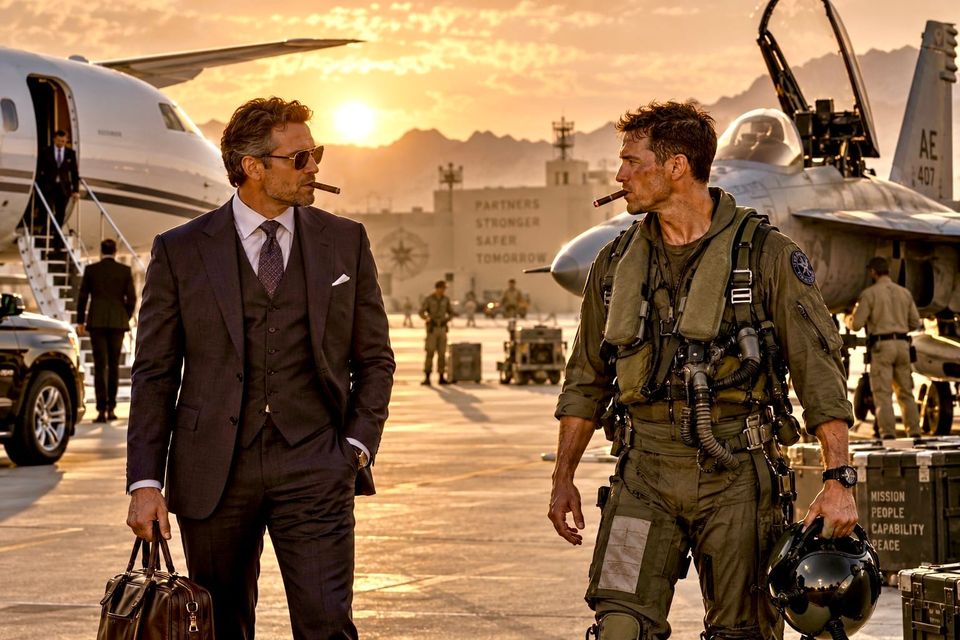
Stay with me. Half of you just rolled your eyes and half of you just got mad, and you got mad for opposite reasons.
If you spent a career in uniform, you think I’m grading a fighter squadron like a car wash. If you spent your career deploying capital, you think I’m dressing up a government cost center in Wall Street vocabulary.
You’re both right. There is no EBITDA of a fighter squadron. A squadron isn’t a business. Nobody’s buying it, there are no shareholders, and the United States Treasury isn’t waiting on the quarterly earnings call.
I’m going to ask the question anyway. I’ve spent enough time in both worlds to realize they have more in common than either side particularly wants to admit. More important, each has developed ways of seeing problems that the other could use.
TWO DICTIONARIES
I wore the Air Force uniform for more than 40 years. Enlisted first, then more than 34 years as a commissioned officer, nearly 30 of them on active duty. I flew F-16s in combat, most of it close air support. I flew LC-130s on skis into Greenland and Antarctica and commanded McMurdo Station. I commanded a wing in Puerto Rico. I served as deputy commander of the Canadian NORAD Region, embedded in the Canadian chain of command and running force employment for an entire air division.
My last Pentagon tour put me in another world. I ran the Joint Rapid Acquisition Cell and the Joint Production Accelerator Cell and served as executive secretary of the Department’s Munitions Acceleration Council. We spent our days worrying about production capacity, supply chains, capital, contracts, factories, labor, demand signals and how fast industry could turn money into weapons.
Along the way, I also taught the Air National Guard Squadron Commander Course for fifteen years. About 2,500 commanders came through it.
But my first education wasn’t military. Before most of that, I spent close to a decade as a manufacturing engineer in the private sector. Before that, I welded rototiller frames on third shift to pay for engineering school.
Since retiring in July, I’ve crossed the table again. I’m chief strategy officer at a venture-backed technology company, advise venture and private-equity investors, and run my own firm helping companies work through customers, capital and production. I read term sheets and cap tables now. During my last two and a half years in the Pentagon, I was also seeing five to ten companies a week and hundreds of industrial projects. I sat beside people who structure debt and equity for a living and learned how they take a company apart, because I needed to understand what they were seeing.
So this isn’t a proposal for a new military accounting system. Please don’t build one. It’s a translation exercise from someone who has needed both dictionaries and never found anyone selling one.
WHAT A COMMANDER ACTUALLY RUNS
Start with what a wing commander runs. A nine-figure enterprise, sometimes ten. Thousands of people. Aircraft, weapons, fuel, parts, facilities, training and a supply chain that can stretch across an ocean. He can’t pick his customers. He usually can’t fire his suppliers. He can’t set prices or walk away from an unprofitable product line. His labor force is partly assigned to him, his capital equipment may be older than the people operating it, and he gets graded on a day he doesn’t get to choose.
When I took command in Puerto Rico, the toilets didn’t flush, the power was unreliable and the aircraft were grounded. Half-finished construction projects sat abandoned around the base. Deferred maintenance wasn’t a line on a spreadsheet. You could see it, smell it and trip over it.
Several hundred million dollars of construction and repair later, the wing was flying again. I’ve met a lot of CEOs since then. I don’t know many who would call that an easy turnaround, and I didn’t get to raise another round when things got tight.
The military has a perfectly legitimate way to measure what commanders produce: readiness. Mission-capable rates, C-ratings, crews qualified against crews assigned, weapons, equipment and people. Those measures let headquarters compare units using a common language. We need them.
They also tend to answer a particular question: can this unit fight the war we told it to prepare for?
Now let me ask a different one.
WHAT DID YOU BORROW TO MAKE THE NUMBER?
Every commander has done some version of this. It’s the third quarter. The ready rate is slipping. You fly hours now that you would rather have later. You pull parts off the jet deep in maintenance to keep three others on the ramp. Your senior instructors carry more of the schedule because the younger crews aren’t ready yet. Maybe you postpone something that can wait because something else can’t.
The C-rating holds. Nobody lied. In some circumstances, that’s exactly what the commander should do. I’ve done it. But you borrowed from tomorrow to make today’s number.
A private-equity associate recognizes the behavior immediately. Deferred capex is one version of it: protecting current performance by consuming something that eventually has to be replenished. Depending on exactly what you did, the finance people can give you five more precise terms for it. I don’t care which one wins the vocabulary contest.
I care that they ask a question I didn’t always ask: what did you consume to produce the number?
I’ve watched investors do this to companies I brought into a room. Now I find myself doing it too. Revenue looks great. Fine. What did it cost you to produce it? What maintenance did you defer? What inventory did you consume? Did you pull demand forward? Is the workforce sustainable? Can you do it again next quarter?
Two groups staring at versions of the same problem with different words for it. That’s the point. Not EBITDA. Translation.
NOW RUN IT FURTHER
What does a fighter squadron actually produce in 72 hours? Not tail numbers on a slide. Complete combat packages, with the crews, weapons, maintenance and support to make them useful. What does each package consume in flying hours, people, parts, weapons and dollars? How hard can you surge tonight, and what can you still produce on day thirty? And the question I wish I had asked more often as a commander: what did I consume to make today’s readiness number, and what am I leaving for the next commander?
Don’t turn any of this into a new spreadsheet. These are simply questions that become easier to see when you borrow someone else’s glasses.
Now take it up a level, because the force itself is entering a period when those other glasses may be particularly useful. The force we have today will not be the force we need for the next war. Some missions will end. Some aircraft will retire. Some organizations will combine. In other places, we’ll take a large formation and break it into smaller pieces that can operate independently across a wider battlespace.
The military has a vocabulary for all of that. So does the capital world: mergers, divestitures, spinouts, consolidation and restructuring. The words aren’t perfectly interchangeable. They don’t need to be.
Consider two units being combined. The military instinct is often to start with the organization chart. Which headquarters survives? Who commands it? Where does it live? Which billets move? Which patch goes on the wall?
An M&A team walks into the same problem from another direction. What exactly are we gaining by putting these organizations together? Which capabilities are complementary? Which are redundant? Where are the hidden dependencies? What disappears when I eliminate one headquarters? Which systems don’t talk to each other? Did I just create a single point of failure? Which three people know how the whole thing actually works, and what happens when two of them leave?
Then comes the question that has haunted plenty of corporate mergers: did we ever capture the value we said the combination would create?
I’d like that question asked more often in military headquarters. Moving two boxes together on a PowerPoint slide is not integration. I’ve watched organizations change on paper far faster than the people, systems and knowledge underneath them could possibly change. Tactical competence can take years to build and an afternoon to delete from an org chart.
The reverse is equally interesting. A large organization designed for peacetime efficiency may be exactly wrong for a battlefield that rewards dispersion. So we break it apart. Smaller formations, more locations, more autonomy, fewer lucrative targets for an enemy. Call it disaggregation. A finance team might recognize elements of a spinout.
Now ask their questions. What has to travel with the new organization for it to survive on its own? Does it have leadership, logistics, communications, maintenance, data and contracting authority? Can it actually make decisions independently? Or have we created something that looks autonomous on the chart but still has to call the mothership every time it needs fuel, a part, a network connection or permission?
The analogy doesn’t have to be perfect for those questions to belong in the room.
THE CAPABILITY THAT LOOKS IDLE
There is another trap in both worlds: things that look terrible when measured only by today’s utilization.
A squadron, skill set, operating location or weapons capability may sit mostly idle. Look at it through a narrow efficiency lens and somebody eventually asks why we’re paying for it. The military answer is often deterrence.
Finance has another useful idea: option value. Sometimes you spend money today to preserve the ability to make a choice tomorrow. You don’t know whether you’ll exercise the option. You hope you won’t have to. That doesn’t make the option worthless.
I learned a version of that lesson on September 11, 2001.
I was a major flying F-16s in Fort Wayne, Indiana. Our unit wasn’t sitting air-defense alert. The post-Cold War force had been built around a world in which we believed we could accept less of that capacity. Then the world changed in a morning.
That night NORAD tasked us to defend Chicago. Live missiles came forward, I slept on an Army cot in my office, and just before midnight I led a two-ship over O’Hare with the controllers telling us the sky was ours. It was a pickup game. We made it work. But I never forgot what it felt like to recreate an option after the moment arrived when we suddenly needed it.
An idle capability and a useless capability are not the same thing.
WHERE THE METAPHOR BREAKS
At this point both tribes have probably accumulated a respectable list of objections. Good. Most of them are probably right.
The most valuable thing a fighter squadron produces may be the war that never happens, and no income statement books an avoided war as revenue. Military units accept risks no board of directors could impose on employees. Governments maintain capabilities for reasons that would look ridiculous on a corporate income statement. A commander doesn’t have shareholders. A squadron can’t go bankrupt. There is no EBITDA. We established that at the beginning.
I’m not interested in the ten reasons the analogy fails. I’m interested in the handful of places where borrowing somebody else’s vocabulary makes us ask a question we weren’t asking before. What are we actually producing, and what does it cost? What are we borrowing from tomorrow? When we merge two organizations, what are we really gaining and what might disappear? When we break one apart, did we give the pieces everything they need to survive? And when something looks inefficient, are we looking at waste or are we looking at an option?
Those questions become more important as missions disappear, units consolidate, formations disperse and old capabilities compete with new ones for finite people and money. Someone with a spreadsheet will be in the room when those decisions get made.
But institutional self-defense isn’t the best reason for commanders to learn this language.
Resource allocation is command. Every flying hour you assign, instructor you use, spare engine you prioritize, weapon you expend, maintainer you move and capability you preserve for tomorrow is a decision about scarce resources. Commanders have been making capital-allocation decisions their entire careers. Nobody handed them that dictionary.
THE CHAPTER I DIDN’T HAVE
So, to the commanders: go learn what EBITDA means.
You’re not becoming a banker. You’ll probably never calculate it for your unit, and I hope nobody makes you. But try the thought experiment. Then learn what a balance sheet is. Learn why an investor asks about deferred capex. Learn what happens after an acquisition closes and everyone discovers that signing the deal was easier than integrating the companies.
You don’t need an MBA. You need enough of the language to turn the organization you’ve been running for twenty years slightly sideways and look at it again.
I taught roughly 2,500 officers how to command a squadron. This is the chapter I didn’t have yet.
And to the people who deploy capital: the next time a retired colonel or general sits across from you and doesn’t speak your language, remember that they spent a career deploying something too. You deploy capital. They deployed combat capability. Different assets, different stakes, and a surprising number of the same problems.
They may have spent decades allocating scarce resources, managing aging capital equipment, trading current output against future capacity, integrating organizations, closing missions, building new ones, managing a workforce that couldn’t easily be replaced and producing through supply shocks. Then, when the call came, they had to deploy the people, equipment and capability they had built and make it work somewhere far from home.
They may not know your words, and you may not know theirs. That’s the gap I’m interested in.
That’s my job now. Handing over the dictionary.
Member discussion