
THE ZIPPER
What does merging onto a German highway have to do with rebuilding the American industrial base? More than I would have imagined.
I’ve spent much of my life around systems that have to move things efficiently: first as an engineer in manufacturing, later moving people and cargo around the world in military aviation, and most recently trying to accelerate the production of weapons and other critical capabilities. The same problem keeps appearing in different forms: How do you get independent actors to arrive at the right place, at the right time, with the right information, without putting one person in charge of everything?
The Germans figured out one elegant answer on their highways.
They call it the Reißverschlussverfahren. The Zipper Procedure.
I spent two years driving on German roads as an American in uniform. Before they would let me do it, I had to earn a U.S. Forces Certificate of License, the old USAREUR card. That meant learning German traffic law, the signs, the Straßenverkehrs-Ordnung, and something the handbook called the doctrine of confidence: you may proceed with the expectation that the other adult on the road will obey the rules and do what he is supposed to do.
That idea stayed with me. Everyone remembers the no-speed-limit stretches, and I enjoyed them too. But what impressed me more was something much slower.
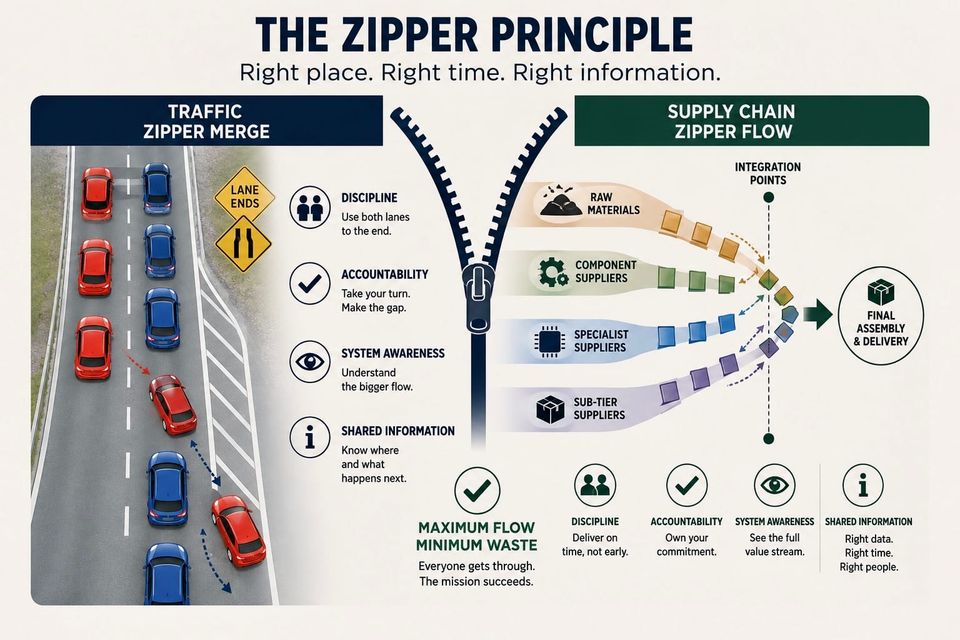
Reißverschluss means zipper. Verfahren means procedure. When a lane ends, German drivers are expected to use both lanes all the way to the constriction. At the merge point they einfädeln, thread themselves in. One car from the continuing lane, one from the ending lane, alternating at the pinch. Seen from above, it looks like a zipper closing.
Americans often merge early and think we’re being polite. In Germany, that’s what you’re not supposed to do. You have abandoned useful road capacity, lengthened the queue, and moved the disruption upstream.
More important, the driver in the continuing lane has an obligation too. He is supposed to make the gap. The merging driver doesn’t have the right to ram his way in, but neither is the continuing driver doing him a favor by letting him enter. Both have jobs. Both know the procedure.
THE ZIPPER ISN’T COURTESY
I’ve come to think of the Reißverschlussverfahren as something larger than a traffic rule. It is a synchronization protocol for strangers.
It takes four things. Discipline: follow the procedure even when something else looks individually advantageous. Accountability: refuse to play your part and you’re not clever, you’re the problem. System awareness: know why using the whole lane improves throughput. Shared information: know where the lanes go, where they end, and what happens at the pinch.
German traffic law even embeds a phrase for it: gegenseitige Rücksicht, mutual consideration. Not socialism, not selflessness. Recognizing that you’re participating in a system with other people.
The doctrine of confidence is the highway cousin of Auftragstaktik, the German practice of mission command: give people intent and information, trust them to execute, hold them accountable. John Boyd built much of his thinking on the same insight. Organizations built on trust and shared orientation can outpace those built on centralized control.
I’m not convinced you can export that culture with a ZIPPER MERGE sign. You’d import the sign, not the system underneath: thousands of people accepting obligations to strangers, sometimes against their own immediate self-interest.
But smaller societies can create those conditions deliberately: a factory, a logistics network, and perhaps best of all, an industrial supply chain.
I started learning that long before the Pentagon.
A TURBOCHARGER THE SIZE OF A VOLKSWAGEN
Early in my engineering career, I worked at TMS in Latham, New York. I started on the shop floor as a quality assurance inspector, moved through manufacturing and quality engineering, and became a test engineer.
We remanufactured locomotive turbochargers, some roughly the size of a Volkswagen Beetle: complicated rotating machines handling hot gases at thousands of RPM. Some components were forgiving; others required very tight tolerances. Get those wrong and eventually physics would explain your mistake.
TMS was founded by Dr. Karol Pilarczyk, a Polish concentration-camp survivor and engineer who hired other talented Polish engineers (and me). That became interesting in the early 1990s, when Poland emerged from Soviet domination and opened its economy to the West.
When we needed specialized cast and machined components, the American supply chain was often expensive, slow, and surprisingly inflexible. Then we discovered something counterintuitive. For some components, we could have manufacturers in Poland make parts to our specifications, put them on a ship across the Atlantic, and still get them into our production system faster and cheaper than working through portions of the American industrial base.
This was more than thirty years ago, before modern digital supply-chain management. Yet geographic distance wasn’t the controlling variable.
Flow was.
The best supplier wasn’t necessarily the one closest to our factory. It was the one that could understand the requirement, hold its lane, pivot to produce the right part, and arrive at the integration point when we needed it.
I didn’t call it a zipper then. But that’s what I was looking at.
EARLY CAN BE JUST AS BAD AS LATE
I learned another version of the lesson through military logistics.
Anyone who has spent time around air mobility knows the term frustrated cargo: something has fallen out of the planned transportation flow and is now sitting somewhere it isn’t supposed to be.
Most people intuitively understand why late cargo is bad. What they don’t always understand is that early cargo can be bad too.
Aerial ports and logistics terminals run on sequencing. Cargo arrives within windows because the system has finite capacity, what mobility operators measure as MOG, maximum on ground: how much can this node absorb before more material degrades the operation? A giant commercial port can hide mistakes with acreage. Much of my flying career took place in austere locations with nowhere to hide anything.
If your ten pallets are scheduled for Tuesday and you dump them on the ramp Monday because you want to clear your warehouse, those pallets don’t magically become Tuesday’s problem.
They’re Monday’s problem.
Somebody has to receive them, secure them, account for them, store them, and move them again when their turn arrives, consuming ramp space, forklifts, and people. In a combat zone they may also be sitting in the open where the enemy can destroy them.
The shipper thinks he got ahead. The system got behind. Optimizing a system requires cooperation greater than the sum of the parts.
That is the American driver in Germany merging lanes half a mile early. He believes he behaved responsibly and helpfully. In reality, he consumed system capacity before the system needed him. The American fouled the works. The objective isn’t to get every tooth into the zipper as early as possible. It is to get every tooth to the right place, at the right time, in the right sequence. Only then will the zipper zip.
THEN I SAW THE SAME THING IN MISSILES
At the Pentagon, among other roles, I served as executive director of the Joint Production Accelerator Cell (JPAC) and as the inaugural executive secretary for the team running the Munitions Acceleration Council (MAC) for the Deputy Secretary of War. We were trying to rapidly increase production across a dozen priority capabilities, primarily munitions. On top of that, over nearly three years, I reviewed hundreds of industrial projects and sat down with five to ten companies a week.
The most useful thing we did was stop staring at the big prime logo on the finished weapon.
We walked down the supply chain. Second tier. Third tier. Sometimes fourth. Sometimes all the way down to the basic mineral coming out of the Earth. We asked the companies making components and materials buried deep inside these weapons a simple question: What would it take for you to produce more and faster?
I irritated some executives at the big defense primes by doing that. In their mind, I was meddling in their supply chain. Upsetting their profitable apple cart.
The traditional arrangement is hierarchical. The government contracts with the prime, the prime with major suppliers, those companies with others. Information and contractual authority are supposed to move through the same structure.
Except sometimes they don’t. More often than we want to admit.
Many sub-tier companies wanted to surge. They had skilled people, specialized equipment, access to capital, ideas about increasing output, sometimes their own money to invest.
But they couldn’t see the road.
They didn’t know enough about future demand to justify another machine or another shift. They couldn’t produce ahead because their contracts didn’t allow it. In some cases, they weren’t given information the government and the prime already had. And sometimes information itself was leverage.
I understand the logic for one corporation negotiating with its suppliers. For a country trying to dramatically increase munitions production, it can be disastrous. And using the zipper analogy, we basically stopped the entire merge.
You cannot tell a supplier to arrive at the merge point at the right time while refusing to tell him where the merge point is, or refusing to issue a contract to support it.
So I called the subtier suppliers. What machine do you need? What tooling? What contract change? What piece of information are you missing?
Sometimes the answer was money. Often it wasn’t.
Our instinct in Washington is to treat industrial capacity as a financial problem: put more money into the prime contract and assume production will emerge from the other end. But money doesn’t machine a casting if the casting supplier doesn’t know demand is coming. It doesn’t create a second source overnight, qualify a new supplier, train a machinist, or make information travel down a supply chain.
A purchase order can buy something. It cannot, by itself, organize a highway.
BUILD THE ZIPPER
So back to the opening question. This is why I’ve become interested in industrial consortia.
A consortium shouldn’t simply be a prime contractor with a longer Christmas-card list. Done correctly, it creates a different geometry. It becomes the place where customers, capital, and production intersect: demand signals reach every lane, capital can price a new machine or a second shift, and production flows toward the pinch instead of waiting for permission.
Imagine a missile not as a pyramid of vendors beneath one corporation, but as a collection of lanes converging at known integration points: energetics, motor, airframe, seeker, electronics, fuze, software, final assembly, and test.
The prime still matters enormously. Somebody must integrate the finished system and answer for its performance. But the prime doesn’t have to be the only adult on the highway. And recent experience has shown that they often fail in that role anyway.
The specialist supplier should know the larger production objective, understand where his lane enters the system, and have enough demand information to make rational investment decisions. He should be expected to use the full capacity of his lane rather than merging prematurely into somebody else’s bureaucracy.
And the company controlling the continuing lane has an obligation too.
It has to leave the gap.
That’s the piece we routinely miss. We write extraordinary contractual requirements telling suppliers what they owe the prime. We spend much less time defining what the larger participants owe the system: information, forecasts, timely decisions, room for somebody else to enter the flow, and interfaces open enough that components are not merely interoperable but interchangeable, able to cross vendors the way a car crosses lanes.
The German zipper works because responsibility runs in both directions. An industrial zipper must do the same.
This isn’t an argument against capitalism. Quite the opposite. A consortium is a bounded environment where market incentives can enforce behaviors that would be hard to impose on an entire society. It is alignment by shared outcomes. Performance can be measured, information sharing made contractual, interfaces standardized. Companies that invest and deliver win more business. Companies that repeatedly frustrate the flow lose it.
We don’t need 340 million Americans to suddenly become Germans.
We need a few hundred industrial participants to agree on the rules of the road.
THE VIEW FROM ABOVE
I’ve now encountered versions of this problem for more than three decades: on a locomotive-turbocharger shop floor, in global mobility operations, and inside the Pentagon trying to accelerate weapons production. The lesson has been consistent.
Local optimization is not system optimization.
The Polish machine shop isn’t too far away if its part arrives when the factory needs it. The pallet isn’t helpful because it arrived early if it consumes tomorrow’s ramp space today. The sub-tier supplier isn’t responsible for failing to surge if we never gave him the information to justify the investment. And the prime isn’t necessarily strengthening the industrial base by pulling everything into its own lane.
Sometimes what looks efficient from the driver’s seat looks ridiculous from 20,000 feet.
That may be the deepest lesson I took from German roads.
Vertrauen, trust, doesn’t mean hoping everyone will be nice. It means designing a system in which I can expect the other participant to know his obligation, have the information to perform it, and be accountable for doing so.
A supply chain capable of arming a nation cannot be supervised tooth by tooth. It has to be designed so the teeth know where they belong.
Hold your lane. Use its capacity. Share the information. Arrive at the pinch at the right time. When it’s your turn, go. When it’s the other guy’s turn, make the gap.
The warfighter isn’t another vendor in the zipper.
He’s the reason we built the road.
Member discussion