
State Capitalism: When the Referee Joins the Game
State capitalism has become a buzzword. Say it on a panel and heads nod. Ask the same panel to define it and you’ll get five different answers. Underneath the buzz sits a real analytic category, but we’ve stretched the term until people use the same words to describe very different things. John Boyd would have recognized the problem immediately. It’s an orientation failure. We’re matching a label instead of observing the mechanism.
The stakes aren’t academic. When government capital gets cheap and abundant, companies can learn to win grants instead of customers. Cap tables warp. Price signals weaken. Talent starts chasing compliance instead of product. A firm built primarily to satisfy a program office eventually becomes difficult to underwrite as a normal business, and an industrial base full of those firms isn’t much of an industrial base. Whatever we decide about government’s role in markets, that’s a failure mode worth designing against.
The state shows up in six roles: customer, referee, lender, guarantor, investor, owner-operator. Each changes the market differently. Lenders and guarantors reshape the capital stack. Investors can reshape the cap table. Owners change governance itself. I underwrite any of them with four questions: Who chooses the winners? Who eats the downside? Does government get governance rights or only economic exposure? How does it end?
I come at this from an unusual angle. Before I flew fighters, I was a manufacturing engineer. Before that, I welded rototiller frames on third shift to pay engineering tuition. Then I spent more than 40 years wearing the Air Force uniform, much of it inside military alliances and later inside the machinery connecting national strategy to industrial production. I didn’t set out to study state capitalism. I kept running into it.
I watched governments make choices about ownership, capital, and regulation, then watched those choices appear somewhere else: in budgets, readiness, supply chains, factories, and eventually combat capability. That made me skeptical of simple labels.
Norway is a good example, and not a secondhand one. I co-chaired the Arctic Security Forces Roundtable and spent years working alongside Norwegian officers and officials. Their government owns a majority stake in Equinor and runs the world’s largest sovereign wealth fund, yet Norwegian markets remain open, competitive, and extraordinarily well run. Canada operates crown corporations alongside one of the most trade-dependent private economies on earth. And I’ve spent time around economies that might politely be described as not so free, where the line between the ministry and the firm exists mostly on paper.
The same label gets applied to all of them. The realities are wildly different.
Puerto Rico: When Policy Outlives the Market
I commanded the 156th Airlift Wing in Puerto Rico for nearly two years. A National Guard base isn’t an isolated federal installation behind a fence. The people serving there live in the community. Their spouses work in the local economy. Economic conditions outside the gate walk through it every morning.
Puerto Rico forced me to ask a basic question. How could an island with fertile soil, a favorable climate, and a long agricultural history become so dependent on imported food? That question led me into the history of sugar.
Federal sugar policy capped returns on cane until a generation stopped entering the industry, and then the mills and the skills left for good. I read about it, but more importantly I talked with people who had lived it. Older Puerto Ricans remembered when agriculture occupied a much larger place in the island economy and had watched that capability recede over decades.
The rum industry made the contradiction vivid. Puerto Rico became famous for rum because cane once grew there in enormous quantities. An island once surrounded by cane now imports much of the molasses used to produce it.
As a former manufacturing guy, I recognized the pattern. Industries rarely disappear the day a policy changes. Skills retire. Equipment gets scrapped. Children choose other careers. Supply chains reorganize. Eventually the policy can disappear while its consequences remain.
Government involvement in a market doesn’t just direct outcomes. Policy can kill an industry on a lag the cap table never prices until the skills are already gone.
Canada: Economic Policy Becomes Military Capability
A few years later I spent two years serving inside the Canadian military as Deputy Commander of the Canadian NORAD Region. I had no role in Canadian economic policy, but I couldn’t do my military job without understanding it.
Every military operates inside an economic envelope. How much a government taxes, borrows, and spends. How it balances social programs against defense. How procurement is structured. How much political tolerance exists for long-term defense investment. All of it eventually determines what commanders actually have.
From my seat, the question was never ideological. What could we buy? How quickly? What could we sustain? Which modernization programs would move, and which would wait?
Canada has since dramatically increased defense spending. But the lesson I carried away predates those decisions: economic policy is not adjacent to military capability. It is the envelope that determines what you can buy, how fast, and for how long. You can separate the finance ministry from the operations center on an organizational chart. You can’t separate them strategically.
Ukraine: When the Bill Arrives
That lesson got harder during my two years at Headquarters, U.S. European Command, where I was part of the initial effort to build the theater mechanisms supporting security assistance to Ukraine. Suddenly industrial capacity wasn’t an abstraction. Weapons were leaving inventories. Demand was accelerating. Consumption rates were exposing assumptions built over decades when few people believed a large conventional war in Europe was likely.
Then came the uncomfortable realization. The capacity wasn’t there. Not just in the United States. Across Europe as well.
Factories optimized for efficient peacetime production couldn’t instantly become wartime arsenals. Skilled labor couldn’t simply be summoned. Suppliers of energetics, motors, castings, machine tools, and specialized components couldn’t multiply overnight. NATO’s leadership now says much the same thing publicly: bigger budgets don’t solve the problem if industry can’t turn money into weapons at the speed and scale the Alliance requires.
That experience changed how I think about government intervention. If a nation needs a production line to exist in wartime, somebody has to pay to preserve it in peacetime. Private markets don’t naturally reward idle capacity. Shareholders generally don’t pay companies to keep dormant factories, excess tooling, unused labor, and deep inventories available for a contingency that may never occur.
The value of that capacity accrues to the nation. The carrying cost sits on a company’s balance sheet. That’s a real market failure, and sometimes government has to intervene. It also makes the exit just as important as the intervention.
The Toolbox
The last chapter of my career put me inside that intervention. I spent the better part of three years working the laws, policies, and programs designed to strengthen the defense industrial base and accelerate delivery of military capability. I reviewed hundreds of industrial projects and watched the Department of War’s capital tools up close: contracts, grants, loans, credit facilities, guarantees, purchase commitments, and increasingly direct equity investments.
I also watched emergency tools work. During COVID, Defense-Assisted Acquisition let other federal agencies use their own money to procure at speed and scale through defense contracting channels. It delivered when the country needed it. It’s also exactly the kind of authority we should be interrogating years later with a simple question: Did it sunset, or did it become furniture?
Every rule I propose below applies to programs I helped run. I’ll also be candid about my bias. The objective was capability in sufficient quantity and on time. When magazines are shallow and production is slow, philosophical arguments about whether government should participate in the market feel remote. You start asking which tool gets the next thousand units out the door.
And in the interest of full disclosure, I now work the private side of the same street, advising companies that compete for some of these very tools. I have skin in this game. Judge the argument accordingly. That bias is also why I believe those of us who favor intervention in some circumstances have a particular obligation to define its limits.
What State Capitalism Actually Means
The term has a legitimate lineage. In comparative political economy, it generally describes systems where government becomes a principal economic actor, owns or controls significant productive assets, or directs capital toward political and national objectives. Ian Bremmer popularized a modern version around 2010: governments using markets themselves as instruments of state power. China’s state-owned enterprises are the obvious example. Russia’s national champions provide another.
The trouble starts when the phrase stretches until any government involvement becomes state capitalism. I find it more useful to separate the roles.
- The state as customer buys what industry produces.
- The state as referee writes and enforces the rules.
- The state as lender supplies credit where commercial markets won’t.
- The state as guarantor absorbs defined risk so private capital will move.
- The state as investor puts taxpayer capital directly into firms.
- The state as owner-operator controls productive assets outright.
I think about markets as the intersection of customers, capital, and production. Customer and referee shape demand and market behavior. Lender, guarantor, and investor shape capital. Owner-operator crosses into direct control of production. A defense contract is not Gazprom. A loan from the Office of Strategic Capital is not a state-owned enterprise. The mechanism matters more than the label.
Which brings me to the window dressing. Our principal competitor has learned to wear our clothes. A Chinese firm can have a Western-style board, audited financials, and a New York listing and still answer to the Party committee down the hall. The shareholders may vote while the state retains the ability to direct the outcome.
Ownership theater isn’t ownership. Governance theater isn’t governance. When the state can direct a firm’s capital, talent, data, and strategic decisions, the paperwork tells only part of the story. That’s state capitalism operating at full strength, however capitalist the exterior may look.
We’re not immune to milder versions of the same physics. Even a passive minority government stake can change behavior because no CEO ignores a shareholder who may also write the rules, regulate the industry, or buy the product. Formal rights can understate practical leverage. Anyone underwriting these companies should price that in.
Crisis Changes the Equation, and Then Refuses to Change Back
The appropriate role of government isn’t constant. A nation at peace with healthy capital markets should hold a very high threshold for direct intervention. A nation at war, or facing a pandemic, financial collapse, natural disaster, or sudden strategic shortage, may reasonably make different choices. I have no philosophical objection to that.
Neither does American history. In the Second World War, we didn’t simply absorb Detroit into the government. We contracted with it, financed it, prioritized materials, shaped demand, and pushed private industry to produce at extraordinary scale. Willow Run remains one of the clearest examples: government demand harnessing private industrial capacity for a national emergency.
My concern begins when temporary necessity becomes permanent architecture. Extraordinary circumstances justify extraordinary authorities. Those authorities solve a problem. Bureaucracies form around them. Industries learn to access them. Constituencies come to depend on them. Then the crisis ends. The authority doesn’t.
Government discovers the mechanism is convenient. Companies discover public capital can be cheaper and more predictable than earning private investment.
There’s a deeper problem too. Every authority built for national security is inherited by whoever governs next, carrying whatever objectives that administration brings. An equity stake normalized for defense becomes precedent for an equity stake taken for some entirely different political priority later. You don’t have to name a party or ideology for that to concern you. It’s structural. Emergency economic power should come with an expiration date by design.
The Four Questions
Rather than argue terminology, I underwrite the arrangement the same way an investor underwrites a deal.
- Who chooses the winners, and by what process?
- Who bears the downside if the bet goes bad?
- Does government receive governance rights, or only economic exposure?
- And how does it end?
That last question is the one I press hardest. Loans have maturities. Contracts expire. Equity can be sold. But exits need to be designed, not assumed. If public capital exists to bridge a market failure, we should know what success looks like: a date, a production target, a private-capital threshold, a defined level of capacity. Without that, the bridge quietly becomes the road.
For anyone deploying private capital into defense and industrial markets, those four questions aren’t academic. They’re policy-risk diligence, as fundamental as reading the cap table.
I saw the same tension in Europe this spring, when I spoke at the Northern European Chiefs of Defence Conference in Vilnius at the invitation of the Commander of U.S. European Command. European governments pursue economic sovereignty, industrial policy, environmental objectives, and domestic political priorities. NATO commanders pursue credible deterrence against a military threat that exists right now. Those systems can point in the same direction. They can also collide.
A regulation that makes sense through an economic or political lens can delay defense production. An industrial policy intended to protect domestic capacity can sometimes restrict access to something commanders need now. Neither institution has to be acting irrationally for the outcome to be bad. Security strategy still has to survive contact with economic policy.
The Line I Would Draw
I don’t believe government should sit permanently on the economic sideline. History doesn’t support that view, and national security sometimes makes it impossible. But crisis can’t become a permanent permission slip.
When extraordinary circumstances require government to move farther into the market, the intervention needs three things: Purpose. Boundaries. Exit.
Use public capital to create or restore a strong private market. Use government power when the market genuinely can’t supply what the nation requires. And once private capital can carry the load, move government back toward the sideline. That should be the default trajectory.
So when someone says state capitalism, don’t accept the label as the argument. Ask what the government is actually doing.
Customer? Referee? Lender? Guarantor? Investor? Owner-operator?
Who chooses? Who pays? Who governs? And how does it end?
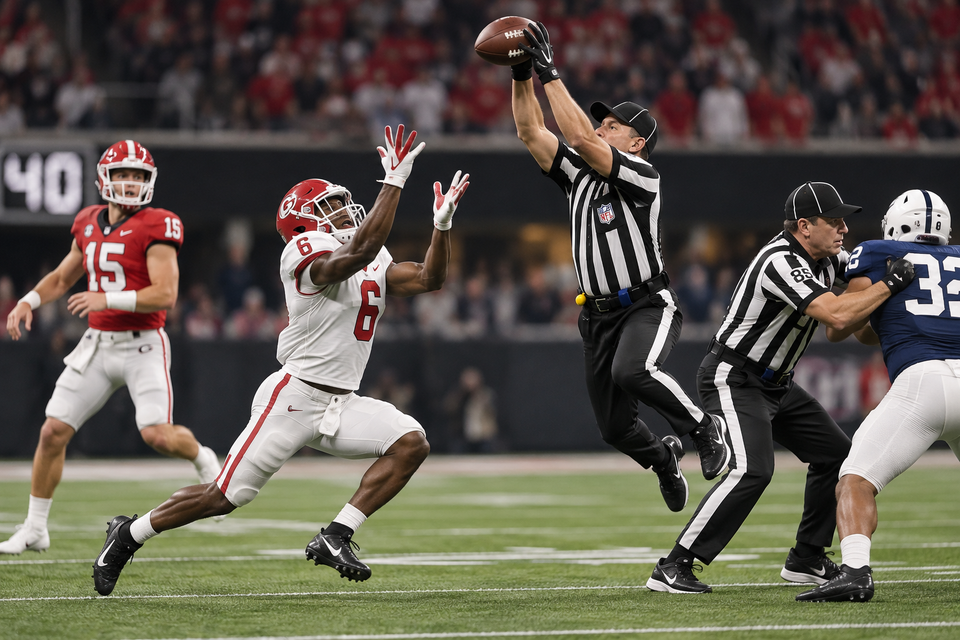
Sometimes the referee has to enter the play. The danger is forgetting he’s supposed to leave it.
Member discussion