
SCARCITY IS A CHOICE
General Colin Powell had a line I’ve always liked: “Perpetual optimism is a force multiplier.” It sounds simple. But Powell wasn’t arguing for blind optimism. He was a soldier, and soldiers don’t get to pretend that terrain, ammunition, weather, casualties or the enemy don’t exist. His point was that once you understand the situation, your attitude toward it affects what happens next. Optimism multiplies the effectiveness of people. Pessimism does the opposite.
He wasn’t alone in thinking this way. General George Marshall told officers that when conditions are difficult and everyone around them is turning critical and pessimistic, “you must be especially cheerful and optimistic.” That wasn’t motivational speaking. Marshall was preparing leaders for war. Eisenhower put it bluntly: “Pessimism never won any battle.”
I’ve come to believe the same thing about scarcity.
Some scarcity is real. There are only so many hours in a day, a factory has a finite number of machines, and a mine holds a finite amount of ore. Physics imposes limits that don’t care about our attitude. But a surprising amount of the scarcity we encounter isn’t physics at all.
It’s something we decided.
OPTIMISM FROM THE DATA
I’ve been lucky over the years to spend time around several people who shaped how I think about this. My encounters with Ray Kurzweil and Peter Diamandis were relatively brief, but both changed the way I thought about exponential technology and what happens when we underestimate compounding progress.
The other two are friends I still correspond with regularly. Dr. Robert Zubrin has spent much of his life arguing that humanity should go farther, particularly to Mars, and that many of the barriers people call insurmountable are engineering problems waiting for someone willing to solve them. Dr. Vint Cerf, one of the fathers of the Internet, has a different style. He’s extraordinarily rigorous. He asks questions, probes assumptions, and wants evidence. Optimism without technical substance doesn’t survive long in a conversation with Vint.
That’s exactly why these people influenced me. Their optimism isn’t disconnected from the data. It comes from the data. They can look at the same facts that make someone else say “we can’t” and see another path.
I’ve seen the same trait in good military leaders. Fleet Admiral Chester Nimitz took command in the Pacific after Pearl Harbor, with the fleet devastated and America unready for the war it suddenly had to fight. His leadership combined determination, optimism, resourcefulness, decisiveness and humility, and that combination is the whole point.
Optimism without resourcefulness is wishful thinking. Optimism plus resourcefulness is a plan.
Flying fighters teaches that distinction quickly. You don’t get to wish away fuel, weather, aircraft performance or an adversary. You have to understand those constraints precisely. But knowing the limits isn’t the same as surrendering to them. The question is what remains possible inside them.
Command reinforces the lesson, and so does working urgent operational problems. Eventually you notice how often organizations confuse “we’ve never done this” with “this can’t be done.”
They aren’t remotely the same thing.
PHYSICS, LAW, OR HABIT?
That became especially clear during my years inside the Pentagon. The building is full of extraordinarily capable people. It’s also full of layer upon layer of process, most of it created for reasons that made sense at the time. Over the years, though, process gets mistaken for law.
Someone says there isn’t enough money, when what they really mean is there isn’t enough money in that particular appropriation. Someone says there’s only one supplier, without asking why. Someone says a production line can’t expand, without naming what actually constrains it. Someone says private capital won’t participate, without asking under what conditions it would. Someone says the government can’t send a strong enough demand signal, without examining which authorities we’ve tried. Someone says a factory takes ten years, without telling you which part takes ten years.
After enough of those conversations, I found myself reducing every problem to a single question:
Is that physics, law, or habit?
Physics deserves respect. Law must be followed. Habit is negotiable.
HOW WE CHOSE SCARCITY
That distinction matters enormously as we confront the condition of the American defense industrial base, and to understand how we got here you have to go back to 1993.
The Cold War had ended and defense spending was falling sharply. Secretary of Defense Les Aspin and Deputy Secretary William Perry gathered senior defense industry executives for the dinner that became known as the Last Supper. The message was straightforward: the government could no longer afford to sustain all of the industry’s existing capacity. Perry later recalled telling the executives that the Department would not pay for unused overhead, and that industry needed to scale down and consolidate.
Given the facts they faced in 1993, that was understandable. It was also a choice.
Industry responded rationally to the signal government gave it. Companies merged, facilities closed, suppliers disappeared, and workforces contracted. Production capacity that looked excessive in a post-Cold War world was eliminated, and roughly fifty major defense firms consolidated into a handful of primes.
For the circumstances of the 1990s there was logic to it. The problem is that the mindset survived long after the circumstances changed.
For roughly thirty years, government and industry became exceptionally good at operating inside scarcity. We optimized inventories, reduced excess capacity, tolerated sole sources and accepted long lead times. We bought sophisticated weapons in relatively small quantities, and industry learned how to produce them profitably under those conditions.
Then the world changed.
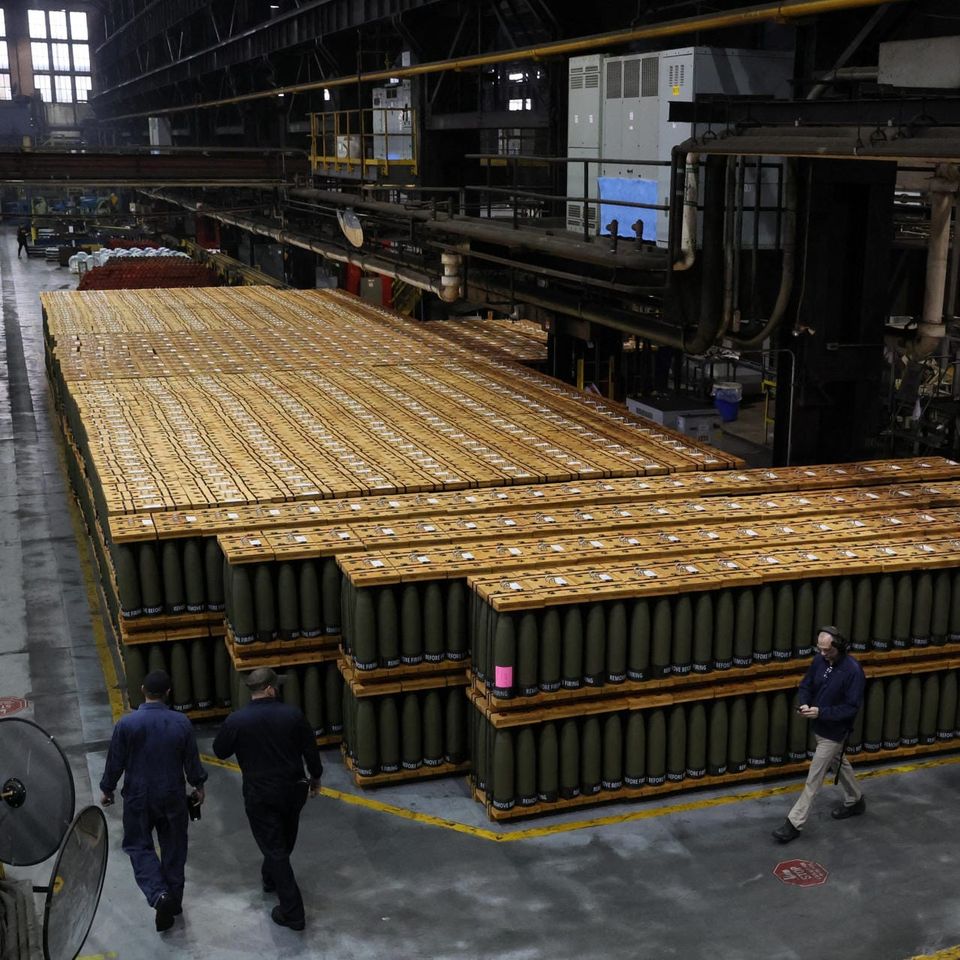
Ukraine reminded everyone what sustained combat does to inventories. The Middle East reinforced the point. The pacing challenge in the Pacific makes the arithmetic even more uncomfortable. Suddenly we’re looking around asking why the warehouses aren’t full.
They aren’t full… because we spent thirty years designing a system that didn’t want them full.
That’s not an indictment of the people who made the original decisions. Perry and Aspin were responding to the world they saw, and industry responded to the incentives government created. The mistake would be treating those decisions as permanent truths, because they aren’t.
A missile production rate isn’t a naturally occurring constant. Neither is the number of suppliers for a rocket motor, the time required to build a factory, the amount of private capital available to an industrial project, or the number of companies capable of producing a component.
Those numbers are outputs from a system. Change the system and you can change the output.
WHAT ABUNDANCE LOOKS LIKE
This is one reason I find the emerging generation of defense companies so interesting. The most important thing some of them bring isn’t a particular drone, missile, software package or manufacturing technique.
It’s a different assumption.
Why not build more? Why not automate more, design for manufacturability from the beginning, bring private capital alongside government money, create another supplier, and build flexible factories that produce families of components instead of one exquisite part?
Why can’t production be measured in thousands instead of dozens?
Those questions make organizations built around scarcity uncomfortable. They also change the economics.
Scarcity, after all, can be very profitable. If there are only one or two qualified suppliers, capacity is limited, qualification takes years, demand is predictable and the barriers to entry are enormous, the companies already inside that system occupy a very strong position. I’m not criticizing them for responding to incentives. Businesses are supposed to make money. But we should understand the incentives we created.
An abundance model changes that equation. Add suppliers and capacity. Bring in competition and private capital. Build manufacturing that can flex when demand changes. And don’t wait for a perfectly defined requirement before beginning to create capacity.
That doesn’t mean throwing money around.
Abundance isn’t waste.
It means recognizing that capital, authorities, technology and industrial capacity can often be combined in ways our existing processes don’t naturally produce.
PUT THE PIECES TOGETHER
I watched versions of this inside the Pentagon. A company would have technology but not enough capital to scale it. An investor had capital but not enough confidence in the government’s demand. A program office had demand but insufficient funding in the right year, while another organization held an authority that could strengthen the demand signal. An ally had production capacity. Another company controlled a critical piece of the supply chain.
Look at each piece separately and you see constraints.
Put the pieces together and sometimes there’s a deal.
That’s where abundance becomes practical. None of those pieces solved the problem alone. Put them together correctly and suddenly you had something executable.
This is also why I don’t see optimism as a personality trait. People sometimes talk about optimists as though they simply wake up happier than everyone else, and maybe some do. But optimism is also a discipline, and so is pessimism. Every day we decide which evidence to emphasize, which assumptions to challenge, and how much agency we believe we have over what happens next.
The Stoics understood this long before any of us. Epictetus drew a sharp line between what’s within our control and what isn’t. Marcus Aurelius wrote repeatedly about turning obstacles into material for action. And John Boyd, in a very different way, taught generations of military thinkers to observe reality, orient to it, decide and act, then do it again faster than the other guy.
None of that means ignoring reality.
It means engaging reality aggressively.
That’s the kind of optimism I recognize in Kurzweil and Diamandis, and even more personally in Robert Zubrin and Vint Cerf. It’s what I recognize in Powell’s force multiplier, Marshall’s insistence on optimism when conditions are worst, Eisenhower’s rejection of pessimism, and Nimitz looking across the wreckage of Pearl Harbor toward the war that still had to be won.
None of them had the luxury of pretending the constraints weren’t real.
They simply refused to give the constraints the final vote.
WE GET TO CHOOSE AGAIN
That’s where I find myself today when people talk about the defense industrial base. I don’t believe America lacks capital. I don’t believe we lack engineers, entrepreneurs, workers, technology, allies, factories or ideas. And after years inside the Pentagon working these problems, I don’t believe we lack government authorities nearly as often as people claim.
What we frequently lack is the willingness to combine what we already have: government demand, private capital, existing authorities, new technology, industrial capacity, allied production, and entrepreneurs willing to take risk.
Put those pieces together differently and something everyone called a constraint on Monday can look very different by Friday.
That’s not blind optimism. It’s an observation from experience.
So when I hear that something can’t be done, I keep coming back to the same question:
Is that physics, law, or habit?
If it’s physics, understand it.
If it’s law, follow it.
If it’s habit, challenge it.
Scarcity is sometimes unavoidable. But sometimes it’s simply the cumulative result of decisions made by people who came before us.
Thirty years ago, faced with a very different world, America chose an industrial model built around scarcity. Today we face a different world, and we get to choose again.
I choose abundance. Now we have to build for it.
Member discussion