
FROM BLACK MOUNTAIN TO DISRUPTIVE SOLUTIONS TO AGI
Nearly Twenty Years Executing in the Age of Surprise
Nvidia CEO Jensen Huang says we’ve reached AGI.
He put it on X this past Sunday, congratulating OpenAI on the launch of GPT-6 Astra: “AGI has arrived.” It wasn’t his first time. Back in March he told Lex Fridman, “I think we’ve achieved AGI,” and Gary Marcus answered within hours that there was no evidence and no definition behind the claim.
Maybe Huang’s right. Maybe historians will draw the line somewhere else. Artificial general intelligence still has no universally accepted definition, and the technological singularity is still a prediction.
What I do remember is the first time I heard serious people talk about both.
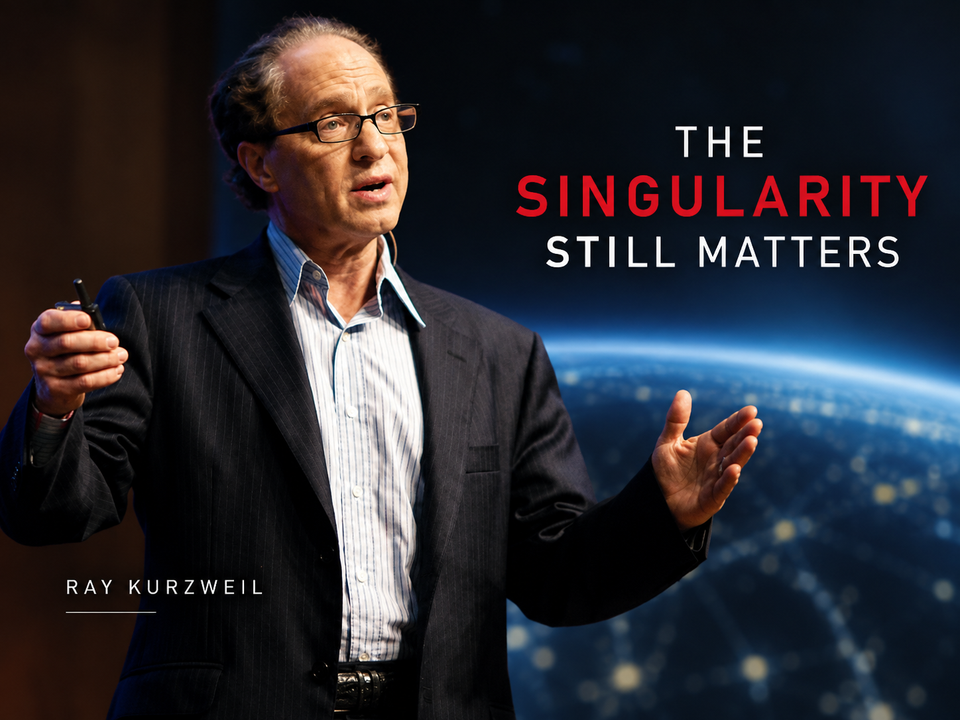
It was October 25, 2008, at the Singularity Summit in San Jose. Ray Kurzweil was there. So was Peter Diamandis. I’d read Kurzweil’s The Singularity Is Near and went because I wanted to know what his exponential curves might mean for national security, and for institutions that still planned in five-year increments.
I didn’t leave San Jose a singularity evangelist. I left with a question that’s followed me for nearly twenty years. What if they’re even partly right?
Oddly enough, I wasn’t supposed to be there at all.
THE PROGRAM I WASN’T SELECTED FOR
I showed up at Air War College in July 2008 as a fairly ordinary lieutenant colonel, and a lucky one. As an Air National Guard officer I’d received an “alternate” allocation. When the officer holding the primary slot picked another college, I got the call asking if I could attend. I said yes and left my job as the Air National Guard’s chief of flight safety for Maxwell Air Force Base.
During one of our first mass informational briefings at the War College, Colonel (Dr.) John Geis described Blue Horizons. It was a small fellowship the Chief of Staff of the Air Force had chartered to look twenty to thirty years into the future and ask what the Air Force should start doing differently today.
There was a quote from Colonel John Boyd on the screen. Geis mentioned Dr. Grant Hammond too. I knew Boyd mostly through the OODA loop, which the Air Force dutifully teaches but, in my view, has never absorbed nearly as deeply as the Marine Corps did through maneuver warfare.
Then Geis explained that Blue Horizons wasn’t taking applications. The fellows had already been picked off their records.
My record hadn’t been considered because I’d arrived as an alternate. But technically, I thought, he hadn’t said I couldn’t ask.
So I wrote him a letter. Longhand.
I described Project Black Mountain, which I’d co-led four years earlier during a combat tour in the CENTCOM theater to connect dissimilar signals among tactical data-link systems that were never designed to talk to one another. I also described the Disruptive Solutions Process, or DSP, that grew out of that experience.
DSP treated the front line field as the source of truth. We mined ideas from units at the edge, ranked them by cost and potential payoff, killed the ones that needed mountains of money, put small demonstration funds against the promising ones, demanded measurable results quickly, and scaled what worked. Fail fast, fail early, fail cheap.
I’d recently received the Chief of Staff of the Air Force Individual Safety Trophy for work that included a lot of those efforts. I didn’t yet know I’d also be picked as the first Reserve component officer inducted into the U.S. Air Force Safety Hall of Fame, partly for creating and running DSP.
Mostly, though, Blue Horizons sounded like a much better way to spend the next year than any of my alternatives.
Apparently nobody had tried applying to the non-application program before.
Geis summoned me to his office. He told me later that he’d planned to thank me for an interesting letter and explain that the answer was no. The class was full. About an hour before our meeting, one of the selected fellows unexpectedly dropped out.
I knew none of this. I walked in ready to sell, and sell I did.
Maybe it was the unusual mix of military and private-sector experience. Maybe it was the energy, or just the peculiar sight of a Guard officer trying to talk his way into a program that didn’t take applications. It could’ve been pity. Whatever it was, Geis let me sit in on the first few sessions on trial. If the rest of the faculty agreed, I could stay.
They did. I became the first Reserve component officer in Blue Horizons.
It was an extraordinary group. One of my classmates was Dr. Rob Spalding, who would go on to found SEMPRE, where nearly two decades later we’d find ourselves working together again. A lot of the relationships from that small fellowship have lasted to this day.
GRANT HAMMOND, BOYD AND THE WAY WE THINK
Blue Horizons put us in front of extraordinary people and places. The biggest intellectual influence on me, though, was Dr. Grant Hammond.
Grant was my professor and mentor, later my colleague, and eventually my friend. He’d also been a friend and contemporary of Col John Boyd and wrote The Mind of War, the first intellectual biography of Boyd. He’d finish his Air University career as its first provost.
Boyd died in 1997, before I got anywhere near these circles, so I never sat across a table from him. Sitting with Grant was about as close as I was going to get.
Oddly, during my fellow year Grant was on a temporary assignment at the NATO Defense College in Rome. His fingerprints were still all over the program. He’d helped shape the course, the reading, and the questions we were being taught to ask, and the faculty consulted him constantly.
Kurzweil’s The Singularity Is Near was on that reading list. That’s how I first ran into the singularity. I read it cover to cover in one sitting.
The deeper relationship with Grant came later, when I returned to Maxwell as Blue Horizons faculty from 2011 to 2013. For two years I sat beside him nearly every day. We built lesson plans, argued about student research and talked about just about anything. Somehow we usually ended up back at Boyd.
Grant saw that some of what I’d worked out through experience in Black Mountain and DSP looked a lot like ideas Boyd had spent decades working out. He pushed me past OODA to Boyd’s 1976 essay Destruction and Creation. That was the Boyd I’d been missing.
Boyd’s deeper point was that our mental models have to be tested against reality, continually. When the model stops matching the world, take it apart and build another one. Grant later called Destruction and Creation the “alpha and omega” of Boyd’s thinking, and that idea has stayed with me ever since.
SAN JOSE, OCTOBER 2008
Blue Horizons wasn’t a fortune-telling shop. We weren’t trying to predict 2035. We were trying to identify forces capable of changing the strategic environment and recommend small course corrections in today’s budgets, policy, doctrine, organizations and people.
The program took us to Lawrence Livermore and Sandia National Laboratories, to Air Force research labs, and to other places I still can’t discuss. Scientists and futurists came to Maxwell as well. Some described fairly dystopian futures. Others saw technology creating extraordinary abundance.
We also had a modest budget for individual field research. I spent some of mine on a trip to San Jose.
The Singularity Summit was still small then, maybe five hundred people in the Montgomery Theater. Access was remarkably easy compared with today’s big technology conferences. An Air Force officer with a notebook and some questions could actually talk to the people on stage.
I met Ray Kurzweil.
I cared less about his famous prediction that the singularity would arrive around 2045 than about the reasoning underneath it. Once something becomes an information technology, Kurzweil argued, it rides accelerating curves of computation, cost and capability. Linear thinkers consistently underestimate what repeated doublings can do.
I’d already felt that mismatch from the other direction. Military bureaucracies moved deliberately. Technology didn’t care. Our planning rhythm and technology’s growth rhythm were coming apart.
I met Peter Diamandis too.
Peter came at the future differently. Where some people saw technological acceleration mainly as a threat, he saw possibility and abundance. His X Prize work showed something that sounded familiar: define an ambitious objective, set clear measures, create incentives, and let people you don’t employ surprise you.
It sounded a lot like DSP.
The Summit had believers and skeptics in the same room. Vernor Vinge, who gave the technological singularity its modern name, was there. Intel’s Justin Rattner talked about the runway still left in computing. Others pushed back on the sweeping predictions.
I wasn’t there to join a congregation. I was a fighter pilot and safety officer trying to answer a practical question. If intelligence and technology really are compounding this fast, what should we be doing differently right now?
THE 25-PAGE PAPER THAT BECAME 130
Every Air War College student had to write a capstone research paper. Normally it ran about twenty-five pages on some acceptable question of national defense or strategy.
I was lucky to have Ted Hailes as my advisor. Along with John Geis and the rest of the Blue Horizons faculty, Ted gave me a lot of room to chase the threads coming together from the lab visits, the guest speakers, Boyd, Kurzweil and San Jose.
My paper got somewhat out of hand.
After cutting it substantially, it was still more than 130 pages. The subject was how to embed ethics and morality into autonomous combat systems, what I rather unapologetically called “ethical warbots.”
The central question seems a lot less theoretical today than it did in 2008. How do we program ethics and morality algorithms into autonomous machines that may someday make decisions in combat?
The paper was so far past Air War College’s length requirements that it wasn’t eligible for the school’s usual research awards. It found a different audience instead. The work got referred to the Aerospace Medical Association’s annual scientific meeting in Los Angeles in May 2009, and I was selected to present a modified version to an international scientific audience. I had to soften the title for the conference. As I recall, “warbots” was one of the words that had to go.
The room was standing-room only. I spoke in my Class-A service dress uniform, and handed out pocket sized copies of the United States Constitution when I was finished.
We certainly didn’t have all the answers. But we were asking questions nearly twenty years ago that have gotten far more immediate. What happens when machines become autonomous enough that human judgment can’t be inserted into every decision? How do we encode values into systems whose behavior we can’t fully anticipate? Where does responsibility live?
Those were futures questions in 2008. Today they sit squarely inside the larger debate over AGI.
WELCOME TO THE AGE OF SURPRISE
When I came back to Blue Horizons as faculty from 2011 to 2013, we’d started using a phrase for the world we were studying. The Age of Surprise.
In 2012 I co-directed and produced a short film for Blue Horizons called Welcome to 2035: The Age of Surprise. We had to create a separate YouTube account to host it because the film was considered controversial inside Air University. It blew past 100,000 views, which at the time made it the most-watched video Air University had ever produced.
Produced and co-directed this video in 2012
The film dealt head-on with accelerating technology and the road toward the singularity. We could see the trajectories in artificial intelligence, bio, nano, cyber, directed energy, additive manufacturing and computing. We could see those technologies starting to converge. What we couldn’t reliably predict were the consequences of the combinations, especially as increasingly powerful technologies landed in the hands of individuals and groups outside traditional institutions.
Wired wrote about the film and read it mostly as a dystopian Air Force warning about Facebook, smartphones and social media. That missed the point. Facebook wasn’t in the film because we thought Facebook was scary. It was there because a technology that barely registered in traditional forecasting a few years earlier had suddenly reorganized how hundreds of millions of people communicated. The surprise was the speed, the scale and the second-order effects.
We weren’t predicting what would happen in 2035. We were saying nobody could. The task was agility.
Between my student and faculty years at Maxwell, Antarctica gave me a very different laboratory for the same idea. In 2010 I deployed to McMurdo Station as the forward commander of the U.S. military detachment supporting the National Science Foundation’s United States Antarctic Program.
The ice is a ruthless instructor. Weather, logistics, aircraft, people and physics interact in ways no briefing can fully anticipate. You observe conditions, make decisions on incomplete information, act, and adjust when the facts change.
The ice does not care about your plan.
BACK TO AGI
Eventually I put a name to the thread running through all of this: relentless execution.
It isn’t a military concept. I use it in business and in my personal life too. Relentless doesn’t mean stubborn. You don’t quit on the objective, and you don’t fall in love with a method that’s stopped working. Execution means closing loops, measuring results, learning and adapting. Sometimes it means killing your own idea because reality says it’s wrong.
Persistence in the objective. Adaptation in the method.
That’s why Huang’s declaration takes me right back to that small theater in San Jose in October 2008.
Maybe this is AGI. Maybe it isn’t. Kurzweil may turn out to be remarkably accurate about the singularity, or technology may follow a path none of us in that theater imagined. I’m less interested these days in winning that argument.
Blue Horizons taught me something more useful nearly twenty years ago. The future doesn’t need our permission to arrive.
Kurzweil gave me language for the curve. Diamandis showed me how incentives could pull possibilities forward. Through Grant Hammond, I came to understand Boyd’s framework for adaptation and recognize some of it in lessons I’d already started learning the hard way. Ted Hailes, John Geis and the rest of the Blue Horizons faculty gave me room to chase those questions much farther than a twenty-five-page assignment.
Looking back, I can see why that October trip stuck. I went to San Jose because a book on a reading list made me curious. I came home thinking about machines with human-level intelligence, the singularity, and what autonomous systems might eventually be trusted to do. Those questions turned into a 130-page paper, followed me back to Blue Horizons as faculty, showed up again in The Age of Surprise, and ran through the rest of my military career and into the work I do today.
The technology changed. The question I carried out of San Jose really hasn’t.
What if they’re even partly right?
If AGI is here, we’ve got work to do. If it’s still ahead of us, we’ve got time to prepare, though probably less than we think. Either way, the Age of Surprise got here a long time ago.
Observe reality. When the model stops matching, change it. Make small moves early. Measure the results. Keep what works. Kill what doesn’t. Keep moving.
That’s how I learned to operate in an uncertain future. After nearly twenty years of thinking about AGI, I haven’t found a better way.
Member discussion